Monday, March 17, 2014

Salida Run Through Time Marathon 2014

Salida Run Through Time Marathon 2014


On Saturday I ran my first official marathon ever - the Salida Run Through Time Marathon. I wasn't planning on running the race, but the night before the Twin Mountain Trudge race I was afraid we would not be able to make it up to the race due to weather and I really wanted to run one race prior to Cedro in April, so Tara and I signed up last minute. I've been doing a lot of slogging and trudging, especially with the G & T challenge, but since January I have not been able to get in many long, steady runs. As such, I was looking at Salida as more of a solid training run then an actual race. Plus, I wanted to finish the marathon strong and go from there.

We drove down and camped Friday night with Kendrick at a spot just outside of Salida. It was great sleeping under the full moon and having a nice fire so early in the season - can't wait for summer. The race morning started off cool and clear, perfect for a day of running through the Pinon and Juniper hills outside of Salida. There were a fair number of heavy hitters at the race, so I was content to just run my own pace and try and work on pacing, fueling, and overall consistency in this race. After a quick fast out-and-back loop on roads, the course comes back to the start and then heads up on singletrack through the hills. At no point does it get very steep, but rather maintains a nice gentle grade of rolling and winding singletrack through the sandy hills with spectacular views of the Collegiate Peaks to the west and the Sangre de Cristo Range to the south. After a bit, the trails end and the course climbs for about 5 miles on a FS road - here is where those who have done adequate tempo training really excelled, as the grade is very gentle and allows roadies to pick up the pace. At the top is an aid station, a quick out-and-back, and then a turn-off onto a much rougher jeep/mountain bike road that rolls through some open meadows and aspen trees before descending back down towards Salida. This section was fun, fast, and snowy, with bits of snow and ice to navigate. Nothing serious, but it did require one's focus.

Parts of the course here are misleading, as you wind along the various draws and canyons in a general south and east direction, often catching glimpses of those ahead of you on the opposite rim. At the 20 mile mark the marathon course re-connects up with the half-marathon course and all of a sudden after running by myself, I started to encounter other runners. This gave me a bit of motivation, but it also became harder to tell when someone was on your tail if they were a marathon or half-marathon runner. I never had any low points, and ran all of the entire course except for one last climb, which pleased me and was one of my goals. I was able to push hard for the final couple miles and really bring it in across the finish, which was nice. I certainly suffered from lack of sustained, long tempo runs (~20ish miles), which would have really helped on this type of course, which is really runnable. I crossed the line in 4:07, which was good for 41st place overall. My first ever marathon in the books!

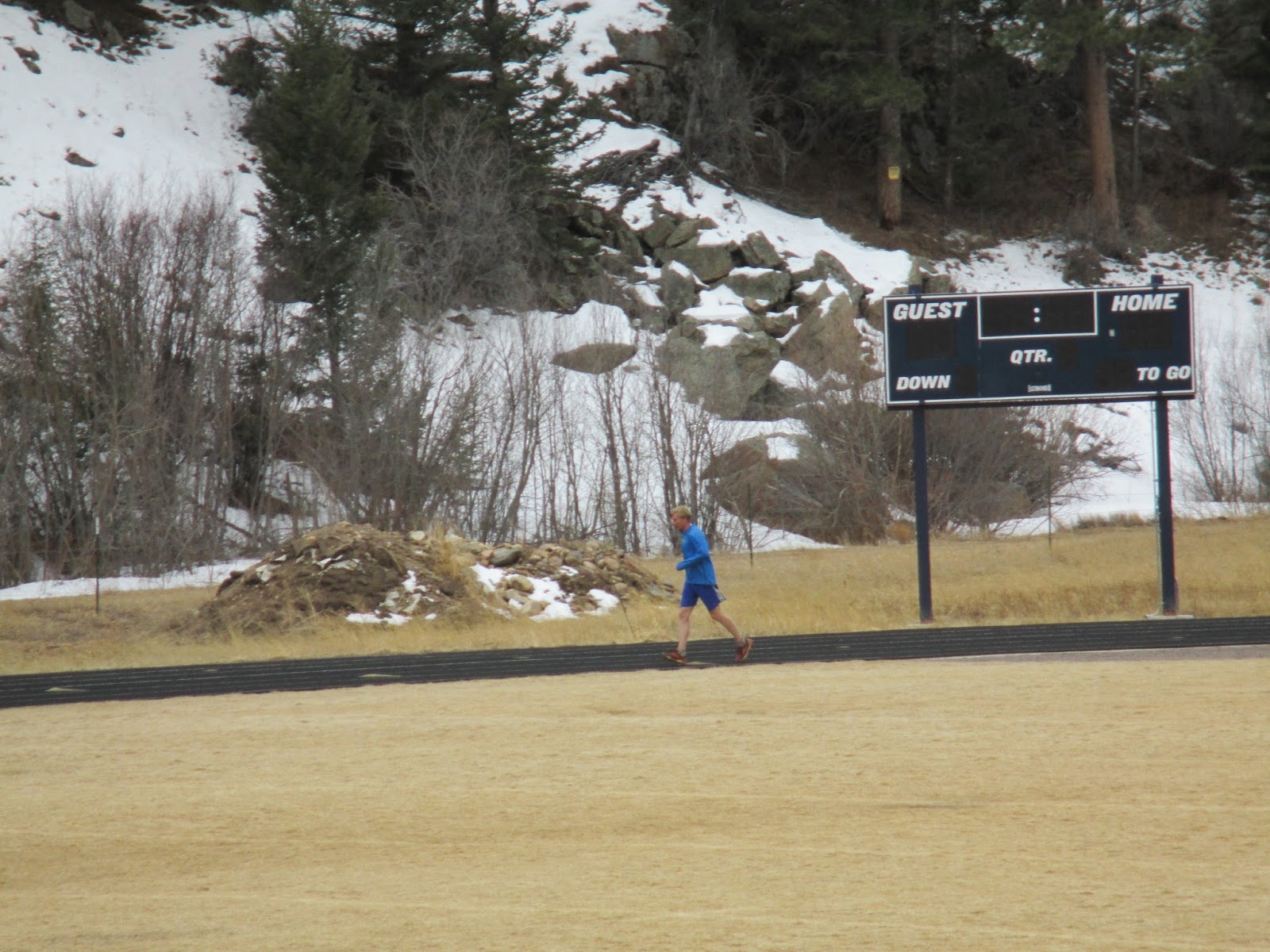
After, on the way home, we stopped at the Platte High School just outside of Bailey to do a track mile for fun. No warm up, just got out of the car after sitting and driving for two hours and did four laps. Then back in the car for the rest of the drive home. It was fairly silly, but also super fun and made the day a bit more adventuresome. Gotta tag a track when you have a chance! My time was 9:16 for the mile - tight and sore....


Monday, March 10, 2014

G & T 30, The Avs Wall, And Supplements

G & T 30, The Avs Wall, and Supplements


Got up in the dark this morning for round 30. It was a bit odd to be back up high prior to the sunrise, but then when I started out, I was rewarded with some amazing early morning light. Not much change from Friday's run other then the foot of fresh that fell Friday afternoon into Saturday. It was packed on the road in to the summer trailhead, but beyond that, once again open country with no trail - postholing nightmare. I thought I might be treated to a rare wind-free day, but once I got up high, it came in strong. I ran into the residential pack of goats, who demonstrated their immunity to the wind and snow.


 Bouldering is a lot like the track in running. It is the purest form of climbing, requiring only shoes and a bit of chalk. Track, to my mind, also seems to be the (or one of) the purest forms of running - shoes and an oval is all you need. Both are "pure" also in their movements. Bouldering requires absolute technique, strength, and power to succeed. Track is the same - to go fast you must have impeccable technique, form, strength, and power. Although I only do track here and there, the analogy comes to my mind often. In celebration of the extra evening light, Tara and I made our way up to the Avs Wall problem on Dinosaur Mountain. It is hard to say, but I believe I put up the FA of this problem way back when. Coming back to it after several seasons was a nice return to a place I spent many hours meditating in the woods, listening to the sound of the wind blow through the sandstone flatirons, contemplating how to link together the blank wall. All of the moves came instantly back, and although I didn't have the strength to do the hard middle section (V10), I did link both the beginning and ending V7s. It was nice to have my bare feet touching the wet dirt as the Flickers and Woodpeckers did their spring thing in the nearby trees.


Finally, perhaps taking supplements is a scam in more ways than one. Just eat real food.

Friday, March 7, 2014

G & T 29

G & T 29


With my only two days this week Friday and Saturday, and with a storm rolling in Friday, I prayed that if I got an early enough start on Friday morning I might be able to make the climb before things got really bad. Waking up at 4:00am everything seemed fine - no rain, no snow, nothing. Driving up to Bakerville the roads were dry, and when I pulled in at Bakerville there was only a light dusting of new snow. My window, however, was soon to close, as everything was socked in and the snow was starting. I took off with extra determination, making my way up to the summer trailhead in good time. It was snowing, but I could still make out the ridgeline of McClellen Mountain so I knew I might still have a chance. No one had been up past the summer trailhead in a couple days, as the "trail" was totally unpacked. Soon, about half way up through the willows, the snow and atmosphere started to close in. If I hadn't already done the peaks a ton and had the route wired, it would easily be possible for someone to get lost in the absolute white of the basin, wandering around in the willows. I know a few of the scraggy trees/willows by heart, so I could just make them out and link the route together. Conditions started to get worse at the Big Sign, as the snow really started to fall. I took a couple shortcuts, and then got on the east ridge before heading straight up the face of Grays and bypassing most of the summer switchbacks. Topping out on the summit was disconcerting, as you could only see a few feet in front of you and the snow was accumulating fast. I flew over to Torreys, slidding down Gray's north ridge and reaching the summit before turning around and trying to figure out the way down. It was like climbing blind, moving by feel alone as I couldn't see anything beyond a few feet. I knew I needed to re-hike up Gray's north ridge a couple hundred feet to safely cross over onto the face before descending the 2,000' back down towards the valley, but I had no idea where since I couldn't see. Finally, I picked a spot and just went out onto the face, hoping that I had climbed high enough to avoid most of the slide hazard. Thankfully, after 28 times I have a pretty good idea and was not too far off. The storm had really rolled in, and I was amazed at how much snow had already fallen in just the last hour or so. By the time I was back down into the valley floor, my tracks were totally covered and there was already about 4-6 inches of fresh powder. When I got back down to the car at Bakersville, it was chaos as I-70 west bound was closed due to multiple crashes and trucks on the side of the road. Luckily, east bound was still open and I was able to make it down before they closed that. A day that would not have been possible if I had not just spent the past 28 weeks on the mountain.

 Snow is starting, but I can still make out the ridgeline so it's not that bad yet...
This was taken looking at Grays and Torreys from the top of the willows...
 This is the big cairn just on the Gray's side of the G&T saddle...
 Summit of Torreys...


Tuesday, March 4, 2014

Mt. Falcon and Brooks Cascadia 8 Critical Review

Mt. Falcon and Brooks Cascadia 8 Critical Review

Ran up Mt. Falcon this morning, taking photos as I went. I really enjoy this run, as I've noted before, simply because you get in some decent vert (~2,000+ depending on the loop) and most of it is more "runnable" than the hill climbs out of Boulder.


I thought I would give a critical review of the Brooks Cascadia 8 shoes as they are a pair that I have been running in for a bit, and since I just picked up another pair, I would give a review after some solid testing. Most, if not all shoe reviews, seem to me like they are done after only one or two runs. The review usually just highlights the new stuff in the shoe, often verbatim from promo material supplied by the shoe company. That is great when a new model comes out and one is thinking about picking it up, but it does little to tell the reader how the shoe will perform over time. So I thought it might be informative to look at how a shoe did after it's running life is (nearly) over.

I got the pair of Cascadia 8s in November, so my review will only be for Nov., Dec., Jan., and Feb. It is important to note that this review focuses on the shoes performance over the winter - plenty of dirt, but lots and lots of snow and ice as well. This I believe has resulted in the sole and the upper lasting longer then if I was reviewing the same shoe for the summer months when they would see significantly more dirt and rocks. Here are the two key stats:
  • 639.5 miles run
  • 180,777 feet of vertical gain

Here are two photos of the shoes as of March 4.

 As you can see, the color and overall look of the shoe has held up well. They are clean and bright because the snow washes them off every time I run; again, the review would be different if I was considering their summer performance. The only thing I've done to modify the shoe is to spray about 5 layers of NikWax on them, which adds a protective seal and prevents wind and snow from passing through the mesh uppers. The blue circles in both photos indicate where critical wear points developed. The way the suede and mesh uppers are sown results in the seam splitting near the outside and inside of the toes. On this pair, I had to use shoe goo to re-glue this seam twice, as it easily snags on anything and tears open. Ideally Brooks would move this seam in version 9 or 10 just a bit up or down so that it does not tear as easily. Another critical wear point is the bottom lace brackets (indicated with blue circles). This is another area that sees high rubbing/friction from regular use, and can easily wear and break. I reinforced mine with a bit of glue, simply because once they tear, there is no way to tie the shoe since these lace brackets are not holes in the suede/mesh fabric, but sown on. The final critical wear point is the suede on the sides of the toe box back to about mid-foot. The suede is sown on to the mesh to help wrap and keep the foot snug, and it does a really good job, but after some serious use, it begins to fray and come apart.

These are really minor overall issues, as any shoe after serious use is going to break down. However, some shoes fare better then others, and simple adjustments could enhance the life of the shoe greatly. As can be seen, the soles of the shoes held up amazingly well. The lugs on the Cascadia 8s are great, providing excellent traction in almost any conditions - ice, packed snow, mud, dirt, talus, etc. They use a hard rubber similar to Vibram, which does not wear down easily. Of course, it is important to remember that this is what the sole looks like after a winter of use, not a summer of use, which I would imagine would cause much more significant wear. 

The midsole, made up of Brooks BioMogo DNA has held up really well. There is some compression if you look closely, but the shoes do not feel flat yet. BioMogo DNA is a combination of Brooks BioMogo midsole compound and it's DNA, which is a non-Newtonian fluid or a fluid whose viscosity is dependent on the amount of stress put on it. This means that the shoe feels both "soft" and "hard" at the same time. If you are running along, the shoe will feel like it has just the right amount of cushioning, but when you start pounding the downhills, because of the added stress put on the midsole, it "stiffens" and protects your feet from the impacts. The yellow bars and triangles circled in green are their "posts" which are supposed to act as independent pivot points that help in balancing the foot and adapting to varying terrain. I don't know exactly how they work, but they are made of a harder EVA rubber.

Obviously I'm really happy with these shoes since I got another pair (I didn't pick up the 9s because they seem to run a bit smaller then the 8s and they got rid of the suede for a glued on fabric which I feel will fray and peel off pretty easy after serious use). My only complaints, as noted above, are the locations of some of the seams which promote tearing, as well as the lace bracket system used. The outsole and lug design are perfect - much better than I've found on many other shoes. I can't say whether the asymmetrical lacing systems is good or bad - I didn't notice either way, but they went back to a straight lacing system for the Cascadia 9s. I can see putting in another ~200 miles on this pair before they are truly dead, which would give me 800+ miles on a pair of shoes. Not bad at all.

Monday, March 3, 2014

Twin Mountain Trudge Race Report

Twin Mountain Trudge Race Report


On Saturday morning, Tara and I got up early to make the drive to the Medicine Bow Wilderness to "run" in the 10th annual Twin Mountain Trudge. Trudge is certainly a good name, as I believe I only ran about 4 of the 22+ miles involved in the race. The race is held on a 11 mile loop encircling Twin Mountain and the surrounding rocks and hills just west of Vedauwoo, a popular climbing area in the summer where I have spent countless hours doing hard and scary trad routes. The toughness of the course varies from year to year depending on the snow depth, as the route follows an untracked loop involving snow covered forest service roads, bush whacking through aspen and pine groves, scrambling over rocks, and just plain silliness in the remote Wyoming wilderness. This year the snow made the course "above average" in difficulty.

We got to the start a bit early to do the mandatory gear check in (you are required to carry certain essential items in case you get lost or stuck out there - space blanket, fire starter, etc.), and hunkered down in our car waiting out the wind and snow until the start. At 10:00 am the RD gave a quick safety speech and we were off. Normally the race starts at the Blair-Wallis picnic area, but with the snow we had to start a bit out from there since it was impossible to reach the area due to the snow. A couple of us took off from the start, running along a snow covered FS road and then down and across an open sage prairie. I took a nice face plant on the first downhill when I sunk in to my hip and the momentum propelled me forward - ah, a fun day I thought to myself. As the race had both 11 milers and 22 milers together, I tried to conserve a little energy and held back on the first loop, staying in 4th place and running with another fellow from Fort Collins. We wound around the Twin Mountain massif first through some open country, then directly through tight aspen groves requiring serious bush whacking. The weather alternated between sun, wind, snow squalls, more sun, more wind, more snow as we continued on our way, up and down, around, and through the snow. I had no idea where I was or how far along the course we had run since everything looks the same, so I was content to run with Mike who had done the Trudge four times previously. It's hard to describe the race, simply imagine the Wyoming backcountry with tons of snow, no real trail, all untracked, and you will get a decent picture.

I finished the first loop in 2:45, good enough for 4th place if I wanted to drop down to the 11 mile race (not sure if it was a true 11 miles, I think because of the added start distance it was around 12-13 miles). I was tired, and the idea of heading out for a second loop was not appealing. I hung around the start/finish, had some soup, soda, and encouraged the few other runners who were trickling in across the line. After about 30 minutes the RD mentioned that only a handful of people had ever completed the full 22+ mile course, and that got a fire in me, so I re-geared up and took off. Not the smartest "racing" strategy, but hey, it's what happened. I was now in the lead, having wasted 30 minutes or more on the next racer, and tried to put my head down and get her done. Of course, since I was now by myself out in the middle of nowhere, I fooled around and took some photos (the only race where I will ever stop to take photos - as well as use wizard sticks). I kept up a solid pace not knowing if I was being chased by others or not. On the second loop, the course had been tracked a bit, but it was not easier, just as hard but in a different way. Now there were some sections with trenches cut through the snow up to my waist, while other sections had already been wind blown and covered. I kinda cursed myself (and the RD) for wasting so much time hemming and hawing and for going out for a second lap as I made my way along the course. Finally, after what seemed like forever, I ran the final section across the open prairie, up the small hill, and then grunted across the finish line for first place. I finished the full 22+ miles in 6:03, with an actual racing time of 5:27 - a time that reflects the difficulty of the course.

This is a great, low-key race on an adventurous, tough course. The RD and volunteers were great, and I can't thank them enough for hosting the event. Hopefully I'll be back next year to run the trudge again!