Around Mt. Falcon, Stretching, Everest, and Videos
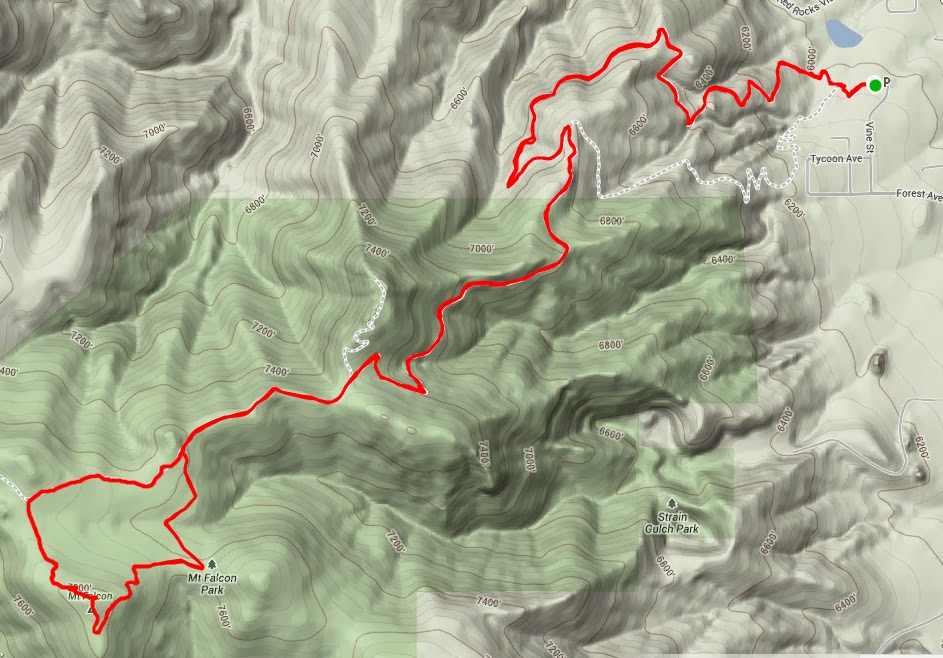
Ran around Mt. Falcon early this morning. I really enjoy doing the outer loop of the peak from the bottom lot - up Turkey Trot, then up to Meadow, Old Ute, Devil's Elbow, Parmalee, Tower, and then back down. The route tags the high points and takes you out to Devil's Elbow for a nice view south on a trail not many travel. Ran into tons of wild turkey tracks today, with only a fleeting glimpse of one turkey in the woods. I think the loop is around 13 miles and 3,000' of gain, which is basically the same as the loop I ran Monday. Need to find one with a few extra miles on it to get into the neighborhood of 16-18 miles.
The New York Times had a post on "reasons not to stretch" which was being passed around FB by some runner friends. I commented that the two articles discussed in the post really argue for not doing greater then 45 second static stretches prior to workouts, and not necessarily to not stretch. Here are the two articles (here and here). I do some 10-20 second "stretches"/poses prior to my runs, along with some leg swings, back cracks, etc. (but really I just warm up as I go), and every night I try and do a 20 minute routine of more static (greater then 30 second) stretching which I believe helps with injury prevention and relaxation. My problem with the NYT article is that it just uses the word "stretching" without any qualifications. The studies themselves make these qualifications, but most people don't read the actual studies. I guess everyone, even the NYT, is looking for clickbait headlines.
I put up a post one of the bouldering areas Tara and I developed over the past 4 years called The Titans just outside of the Indian Peaks on the west side of the Divide. I back dated it and kept it fairly vague so that the area retains it's adventuring feel.
I won't get into the whole Everest thing, as it has been out of control for years now and I have no desire to climb the peak, at least not using expedition style means. However, I like to honor the early pioneers, and on this day in 1983 Swiss alpinist and mountaineer Edouard Wyss-Dunant passed away. I mention him because he led the 1952 Swiss expedition to Everest that was responsible for opening up the Khumbu Icefall (the location of this years tragic avalanche). This is now the standard route on Everest, but back then it was an unprecedented success to just get through the Khumbu and make it to the South Col. He also was a doctor and coined the term "the death zone" which is anything above 8,000m. Here is a video on the expedition with cool historical footage:
Finally, Salomon has released their final episode of Season 3 on Emelie Forsberg. Another great piece of eye candy for sure!
Showing posts with label Mt. Falcon. Show all posts
Wednesday, April 30, 2014
Tuesday, March 4, 2014
Mt. Falcon and Brooks Cascadia 8 Critical Review
Ran up Mt. Falcon this morning, taking photos as I went. I really enjoy this run, as I've noted before, simply because you get in some decent vert (~2,000+ depending on the loop) and most of it is more "runnable" than the hill climbs out of Boulder.
I thought I would give a critical review of the Brooks Cascadia 8 shoes as they are a pair that I have been running in for a bit, and since I just picked up another pair, I would give a review after some solid testing. Most, if not all shoe reviews, seem to me like they are done after only one or two runs. The review usually just highlights the new stuff in the shoe, often verbatim from promo material supplied by the shoe company. That is great when a new model comes out and one is thinking about picking it up, but it does little to tell the reader how the shoe will perform over time. So I thought it might be informative to look at how a shoe did after it's running life is (nearly) over.
I got the pair of Cascadia 8s in November, so my review will only be for Nov., Dec., Jan., and Feb. It is important to note that this review focuses on the shoes performance over the winter - plenty of dirt, but lots and lots of snow and ice as well. This I believe has resulted in the sole and the upper lasting longer then if I was reviewing the same shoe for the summer months when they would see significantly more dirt and rocks. Here are the two key stats:
Here are two photos of the shoes as of March 4.
As you can see, the color and overall look of the shoe has held up well. They are clean and bright because the snow washes them off every time I run; again, the review would be different if I was considering their summer performance. The only thing I've done to modify the shoe is to spray about 5 layers of NikWax on them, which adds a protective seal and prevents wind and snow from passing through the mesh uppers. The blue circles in both photos indicate where critical wear points developed. The way the suede and mesh uppers are sown results in the seam splitting near the outside and inside of the toes. On this pair, I had to use shoe goo to re-glue this seam twice, as it easily snags on anything and tears open. Ideally Brooks would move this seam in version 9 or 10 just a bit up or down so that it does not tear as easily. Another critical wear point is the bottom lace brackets (indicated with blue circles). This is another area that sees high rubbing/friction from regular use, and can easily wear and break. I reinforced mine with a bit of glue, simply because once they tear, there is no way to tie the shoe since these lace brackets are not holes in the suede/mesh fabric, but sown on. The final critical wear point is the suede on the sides of the toe box back to about mid-foot. The suede is sown on to the mesh to help wrap and keep the foot snug, and it does a really good job, but after some serious use, it begins to fray and come apart.
These are really minor overall issues, as any shoe after serious use is going to break down. However, some shoes fare better then others, and simple adjustments could enhance the life of the shoe greatly. As can be seen, the soles of the shoes held up amazingly well. The lugs on the Cascadia 8s are great, providing excellent traction in almost any conditions - ice, packed snow, mud, dirt, talus, etc. They use a hard rubber similar to Vibram, which does not wear down easily. Of course, it is important to remember that this is what the sole looks like after a winter of use, not a summer of use, which I would imagine would cause much more significant wear.
The midsole, made up of Brooks BioMogo DNA has held up really well. There is some compression if you look closely, but the shoes do not feel flat yet. BioMogo DNA is a combination of Brooks BioMogo midsole compound and it's DNA, which is a non-Newtonian fluid or a fluid whose viscosity is dependent on the amount of stress put on it. This means that the shoe feels both "soft" and "hard" at the same time. If you are running along, the shoe will feel like it has just the right amount of cushioning, but when you start pounding the downhills, because of the added stress put on the midsole, it "stiffens" and protects your feet from the impacts. The yellow bars and triangles circled in green are their "posts" which are supposed to act as independent pivot points that help in balancing the foot and adapting to varying terrain. I don't know exactly how they work, but they are made of a harder EVA rubber.
Obviously I'm really happy with these shoes since I got another pair (I didn't pick up the 9s because they seem to run a bit smaller then the 8s and they got rid of the suede for a glued on fabric which I feel will fray and peel off pretty easy after serious use). My only complaints, as noted above, are the locations of some of the seams which promote tearing, as well as the lace bracket system used. The outsole and lug design are perfect - much better than I've found on many other shoes. I can't say whether the asymmetrical lacing systems is good or bad - I didn't notice either way, but they went back to a straight lacing system for the Cascadia 9s. I can see putting in another ~200 miles on this pair before they are truly dead, which would give me 800+ miles on a pair of shoes. Not bad at all.
Ran up Mt. Falcon this morning, taking photos as I went. I really enjoy this run, as I've noted before, simply because you get in some decent vert (~2,000+ depending on the loop) and most of it is more "runnable" than the hill climbs out of Boulder.
I thought I would give a critical review of the Brooks Cascadia 8 shoes as they are a pair that I have been running in for a bit, and since I just picked up another pair, I would give a review after some solid testing. Most, if not all shoe reviews, seem to me like they are done after only one or two runs. The review usually just highlights the new stuff in the shoe, often verbatim from promo material supplied by the shoe company. That is great when a new model comes out and one is thinking about picking it up, but it does little to tell the reader how the shoe will perform over time. So I thought it might be informative to look at how a shoe did after it's running life is (nearly) over.
I got the pair of Cascadia 8s in November, so my review will only be for Nov., Dec., Jan., and Feb. It is important to note that this review focuses on the shoes performance over the winter - plenty of dirt, but lots and lots of snow and ice as well. This I believe has resulted in the sole and the upper lasting longer then if I was reviewing the same shoe for the summer months when they would see significantly more dirt and rocks. Here are the two key stats:
- 639.5 miles run
- 180,777 feet of vertical gain
Here are two photos of the shoes as of March 4.
As you can see, the color and overall look of the shoe has held up well. They are clean and bright because the snow washes them off every time I run; again, the review would be different if I was considering their summer performance. The only thing I've done to modify the shoe is to spray about 5 layers of NikWax on them, which adds a protective seal and prevents wind and snow from passing through the mesh uppers. The blue circles in both photos indicate where critical wear points developed. The way the suede and mesh uppers are sown results in the seam splitting near the outside and inside of the toes. On this pair, I had to use shoe goo to re-glue this seam twice, as it easily snags on anything and tears open. Ideally Brooks would move this seam in version 9 or 10 just a bit up or down so that it does not tear as easily. Another critical wear point is the bottom lace brackets (indicated with blue circles). This is another area that sees high rubbing/friction from regular use, and can easily wear and break. I reinforced mine with a bit of glue, simply because once they tear, there is no way to tie the shoe since these lace brackets are not holes in the suede/mesh fabric, but sown on. The final critical wear point is the suede on the sides of the toe box back to about mid-foot. The suede is sown on to the mesh to help wrap and keep the foot snug, and it does a really good job, but after some serious use, it begins to fray and come apart.
These are really minor overall issues, as any shoe after serious use is going to break down. However, some shoes fare better then others, and simple adjustments could enhance the life of the shoe greatly. As can be seen, the soles of the shoes held up amazingly well. The lugs on the Cascadia 8s are great, providing excellent traction in almost any conditions - ice, packed snow, mud, dirt, talus, etc. They use a hard rubber similar to Vibram, which does not wear down easily. Of course, it is important to remember that this is what the sole looks like after a winter of use, not a summer of use, which I would imagine would cause much more significant wear.
The midsole, made up of Brooks BioMogo DNA has held up really well. There is some compression if you look closely, but the shoes do not feel flat yet. BioMogo DNA is a combination of Brooks BioMogo midsole compound and it's DNA, which is a non-Newtonian fluid or a fluid whose viscosity is dependent on the amount of stress put on it. This means that the shoe feels both "soft" and "hard" at the same time. If you are running along, the shoe will feel like it has just the right amount of cushioning, but when you start pounding the downhills, because of the added stress put on the midsole, it "stiffens" and protects your feet from the impacts. The yellow bars and triangles circled in green are their "posts" which are supposed to act as independent pivot points that help in balancing the foot and adapting to varying terrain. I don't know exactly how they work, but they are made of a harder EVA rubber.
Obviously I'm really happy with these shoes since I got another pair (I didn't pick up the 9s because they seem to run a bit smaller then the 8s and they got rid of the suede for a glued on fabric which I feel will fray and peel off pretty easy after serious use). My only complaints, as noted above, are the locations of some of the seams which promote tearing, as well as the lace bracket system used. The outsole and lug design are perfect - much better than I've found on many other shoes. I can't say whether the asymmetrical lacing systems is good or bad - I didn't notice either way, but they went back to a straight lacing system for the Cascadia 9s. I can see putting in another ~200 miles on this pair before they are truly dead, which would give me 800+ miles on a pair of shoes. Not bad at all.
Monday, February 10, 2014
Saturday Marathon
Saturday Marathon
With another long run on tap, William and I decided to try and link together a bunch of parks and open space in Jefferson County instead of doing one of the usual loops up in Boulder. Boulder is great - I grew up there and have run those trails forever - but the idea of an adventure run closer to home was appealing. Allisa had mentioned a crazy 100K route that linked up a ton of parks - we were not up for that, but still wanted to do something similar, so we devised a plan and headed out. We parked at the top of the Mathews/Winter trailhead and headed up the Red Rocks trail. At the top of the mesa, we went bushwacking straight up the northeast ridge of Mt. Morrison. This turned out to be a bit of a saga, as the snow was ankle to calf deep the entire way - not more slogging! Near the top, you have to go around a bunch of radio towers with various warnings about radio frequency exposure and FCC guidelines. Finally, at the top of Mt. Morrison we ran down the super fun and fast southeast ridge to Morrison and Bear Creek. A quick run through some urban streets and we were hooked up with the Mt. Falcon trail system. Up that we went - the trail was packed out, but the wind up top was roaring and had us back to a slogging pace. At the top of Falcon, we dropped off the backside and down through the Indian Hills area. Our original plan was to then jump onto the O'Fallon/Lair O'Bear trails which would take us to the small hamlet of Idledale. When we got to the trails, they were totally untracked and our desire to turn this run into a mega epic (it was already turning into a mini epic) quickly convinced us to just cruz down Myers Gulch to the hamlet of Kittredge and then onto the lower Bear Creek trails. Once in Idledale, we had to run a couple miles along the side of the road to get back to Morrison, where we turned and went up through Red Rocks and back along the trails to get to our starting point. The run turned out to be almost exactly 26.2 miles (26 via Google Earth) and 6,477 feet of gain. I was blasted by the end, with William dropping me four or five times. It was a great training run, incorporating some good climbing and a fair amount of real running. As seems to be the usual habit, I took some photos during the first half, but nothing during the second half.
Slogging up Mt. Morrison
Views from the top of Mt. Morrison
Windy madness along the Divide
The meadow at the top of Falcon
Friday, December 20, 2013
Upslope
Upslope
A dense upslope rolled in last night, putting a nice freeze on the Front Range. Running up Mt. Falcon, however, got one up above the cloud bank for some nice running. I really like this run, the west Denver version of Green Mountain out of Boulder. Almost the same vert (2,100 vs. 2,300), but a bit longer (8.5 miles vs. ~6.5 miles), with some fun loops up top that don't see much traffic.
Mt. Morrison poking above the cloud bank...
Descending back down into the fog and mist...
New article on injury risk and minimalist shoes. Pretty straight forward and common sense, although I would argue that it might take longer then 12 weeks for one to really adapt to minimalist shoes and not end up with any injuries.
Friday, December 6, 2013
Cold Mt. Falcon
Cold Mt. Falcon
Day two of the cold snap, and not much better. I tried to hold off on running this morning, hoping that it would warm up just a touch. No luck, still -3 when I set off. Despite the frosty temps and ample snow, it was still a great run. No one else was out, and with the bitter cold and snow a nice quiet atmosphere permeated the run.
Rocking the eyelashicles...
Looking northeast from the top...
Looking west at the Divide...
Friday, November 15, 2013
Mt. Falcon X 4
Mt. Falcon X 4
The goal was to get out for an extended period of time, and to try and get in some vertical. I was looking for something where I didn't have to carry all of my food and water, but still had a decent amount of miles and vert per lap. Green Mountain via one of the front side trails was my first choice, but since that is still closed, I opted for laps on Mt. Falcon. The route is straightforward, up to the fire lookout and back down. Each lap is 8.5 miles and 2,100' of gain. I wasn't looking to push the pace, but rather to keep moving up and down for an extended period of time, and to focus on any mental issues that might arise. After allowing myself an extra hour of sleep to try and catch up from a busy week, I got moving at 8:06 in the morning. Regularly, when I run this route semi-hard, it takes me ~1:20, so I was aiming for just under 2 hours per lap on this day. The day started off a bit cool, but quickly warmed up and I was in summer mode for the rest of the day. The first lap went well, and I finished it off in around 1:45 at a very comfortable pace. A quick stop at the car for some food and water, and I was off again after a couple minutes. The second lap went well, and my energy level seemed to be holding. The third and fourth also went well. I was worried that I would get bored and throw in the towel prior to reaching four laps, so I had that goal in the back of my mind all day. I also wanted to try and keep a mellow but even pace all day, which I was able to do. So, overall the day was a success. I still had enough energy after the fourth lap to go for another, but decided to call it at four - a solid training day with my goals accomplished. 34 miles, 8,400' of gain, 6h 53m. Project N training.
Subscribe to:
Posts (Atom)