Trying to Get Verticle
During the winter, it is pretty hard to get big vert in here in the valley. My "standard" run only has 1,000' of vert in about ~8.5 miles. Most everything else has less vert, as the mountains are buried deep in snow and the valley is the only place to run. However, last night I came up with a super fun new hill challenge that I think any mountain runner could dig - run up Mary Jane! Yep, just run right up the damn ski hill. Last night was my first go, so still working out the kinks, but here are the basics:
Park at the base of Mary Jane.
Start your watch at the Iron Horse Lift.
Run/Speed Hike up Jane Trail to the top of the Iron Horse Life.
It is 1.4 miles and ~1,800' of vert. For my first attempt, it took me 28:41 to get to the top. That's going from 9,400' to 11,200'. Then you run right back down Jane Trail, turn around, and do it again. I did it twice and boy is it a fun workout. Going up is no problem - the run is either groomed or snow packed slopes so you don't have to worry. Going down is another story. I don't have any form of traction (yet, I just ordered some...) so I had to pick my way down on some of the steeper stuff, but otherwise, with traction, it should be no problem. I was just over 1 hour for the double round trip effort. Bringing it below 1 hour is the goal. That would give you 3,600' of gain in 2.8 miles or 7,200' total over 5.6 miles. My plan is to incorporate this run at least once a week and see if I can't lower the total time to below 1 hour. If anyone wants to join in, I am starting it Saturday nights at 5:15 pm.
Showing posts with label trail running. Show all posts
Showing posts with label trail running. Show all posts
Monday, January 14, 2013

Monday, November 19, 2012
Weekend And Night Running
Weekend and Night Running
Friday: Off - 6 hours walking and standing
Saturday: 6 hours walking and standing. Interval workout at night. Started my first speed training this week. Since there is no track in the valley, I basically did fartleks on the St. Louis road in the dark. Started with a 10 minute warmup, then 4 x :30 seconds sprint, 10 x 1:00-1:30 sprints, then 3 mile cool down. Total of around 8 miles in 56:29. I wanted to do 4x30, 4x1:00, and 4x2:00 but since it was dark out I couldn't really time myself so I went on perceived time, which ended up being more between 1:00 and 1:30 with a couple near 2:00. Really enjoyed the workout, and plan on doing a speed workout once a week since I obviously need it. Ran the entire thing in stealth mode, except for the last 3 mile cool down which was on the Northwest trail.
Sunday: 6 hours walking and standing. Another night run, this time up Zoom, then along the waterboard road to Elk Creek and back down. ~8.5 miles, 1,400' gain, 58:16. Lots of snow on Zoom, with no tracks, so it was a fun slog run up. Once on the waterboard road, the running was smoother, but everything is snow covered, which slowed things down some. Felt surprisingly good after 3 days of standing and walking and last nights workout. Trying to figure out a good long run for this winter, which will be hard because of the snow...
Really enjoy running at night. An entirely different experience, which lots more "mystery" in the run. I wear a Tikka headlamp, but try and run as much in stealth mode as possible for skills development.


Friday: Off - 6 hours walking and standing
Saturday: 6 hours walking and standing. Interval workout at night. Started my first speed training this week. Since there is no track in the valley, I basically did fartleks on the St. Louis road in the dark. Started with a 10 minute warmup, then 4 x :30 seconds sprint, 10 x 1:00-1:30 sprints, then 3 mile cool down. Total of around 8 miles in 56:29. I wanted to do 4x30, 4x1:00, and 4x2:00 but since it was dark out I couldn't really time myself so I went on perceived time, which ended up being more between 1:00 and 1:30 with a couple near 2:00. Really enjoyed the workout, and plan on doing a speed workout once a week since I obviously need it. Ran the entire thing in stealth mode, except for the last 3 mile cool down which was on the Northwest trail.
Sunday: 6 hours walking and standing. Another night run, this time up Zoom, then along the waterboard road to Elk Creek and back down. ~8.5 miles, 1,400' gain, 58:16. Lots of snow on Zoom, with no tracks, so it was a fun slog run up. Once on the waterboard road, the running was smoother, but everything is snow covered, which slowed things down some. Felt surprisingly good after 3 days of standing and walking and last nights workout. Trying to figure out a good long run for this winter, which will be hard because of the snow...
Really enjoy running at night. An entirely different experience, which lots more "mystery" in the run. I wear a Tikka headlamp, but try and run as much in stealth mode as possible for skills development.
Just a bit of light at the start of the run, enough for stealth mode.
Only a sliver of a moon for light by the end - it gets real dark out in the valley at night!
Wednesday, November 14, 2012
Winter Running
Winter Running
The winter season is in full swing here in the valley. Both Winter Park and Fraser have their holiday lights up, snow is on the ground, and the resort opened today. Depending on how much snow we get, it will be interesting to see how well I am able to keep up the running over the winter. The plan, as mentioned prior, is to get in as much telemark and cross-country skiing as possible to keep up a solid fitness. However, I plan on running still a couple times a week. I did the standard 8 mile Creekside/Fools/Flume loop the other day, which normally takes me between :54 and 1:08 (:54 is my PR, :58 is my average, and 1:08 is my slowest), and it took me 1:08 to complete. With anywhere from 3" to 10" of snow on the trail, my time was significantly slowed despite feeling really good. However, snow running does require more work, and also works the legs slightly differently (almost like running on the beach, with more calf muscle use), so a slower time is expected. Either way, it will be interesting to see what I can pull together. Today we skied around 20,000' at the resort. 20,000' of lunges gets a nice burn in the quads going, that is for sure.

The winter season is in full swing here in the valley. Both Winter Park and Fraser have their holiday lights up, snow is on the ground, and the resort opened today. Depending on how much snow we get, it will be interesting to see how well I am able to keep up the running over the winter. The plan, as mentioned prior, is to get in as much telemark and cross-country skiing as possible to keep up a solid fitness. However, I plan on running still a couple times a week. I did the standard 8 mile Creekside/Fools/Flume loop the other day, which normally takes me between :54 and 1:08 (:54 is my PR, :58 is my average, and 1:08 is my slowest), and it took me 1:08 to complete. With anywhere from 3" to 10" of snow on the trail, my time was significantly slowed despite feeling really good. However, snow running does require more work, and also works the legs slightly differently (almost like running on the beach, with more calf muscle use), so a slower time is expected. Either way, it will be interesting to see what I can pull together. Today we skied around 20,000' at the resort. 20,000' of lunges gets a nice burn in the quads going, that is for sure.
Monday, October 29, 2012
Week In Review - More Barefoot Running Analysis And Socks And Blisters
Week in Review - More Barefoot Running Analysis and Socks and Blisters
Tuesday: 8 miles, 1,000' gain - 54:33 Went fast today, felt good. For the Creekside/Flume with a tag of Fools Creek this is my new PR for the loop.
Wednesday: 9 miles, 1,700' gain - Deadhorse again. Took me 1:21 today. Some snow still on the north side.
Thursday: 8 miles, 1,000' gain - 1:03 Slow today; tired. Amazing how much slower on this loop from just Tuesday's PR.
Friday: Off - 6 hours standing and walking.
Saturday: Off - 6 hours standing and walking.
Sunday: The race got moved to next weekend because the trails were muddy. I know, trail races are supposed to be muddy. However, according to the RD, in 2009 someone complained to Jefferson Parks after the race about the trail conditions, and now Jefferson Parks will not allow any races when trails are not "perfect." Oh well, another week of taper. Went skiing instead. 27,000' of descent. First day back on the tele's. Quads, stomach, and shoulders are worked!
Monday: 8 miles, 1,000' gain - 58:55 Faster then Thursday, but slower then Tuesday. Amazing to keep track of how one's time fluctuates, especially since my phenomenological experiences on the loop were relatively the same each time, although today did not feel too bad and I know on Thursday that I was tired and slow.
Two new studies have been published. The first is entitled "Changes in lower extremity movement and power absorption during forefoot striking and barefoot running." Like the other studies involving barefoot running, the authors wanted to look at the effects of barefoot and forefoot striking had on lower extremity movement and power absorption. The authors found that running with a forefoot striking pattern (which occurs in barefoot running or just running with a forefoot strike) resulted in reduced total lower extremity power, hip power and knee power. Furthermore, the authors also found that there was a shift of power absorption from the knee to the ankle. So, rearfoot (or traditional) running results in more power absorption from the knee, while running barefoot or on the forefoot results in more power absorption from the ankle. An interesting side note of this study is that the authors found it is more about the strike pattern and not being barefoot per se - alterations associated with barefoot running patterns are present in a forefoot pattern when wearing shoes.
The second study looked at running sock structure and blisters. It is an interesting idea, in that the particular weave pattern used to make a sock may influence blister formation in runners. The authors found that a plain jersey knitted pattern with two yarns were found to be most suitable for running socks. Great, so what is a plain jersey knitted pattern? Well, jersey knit simply means a single-knit, plain-stitched fabric with a face side that is markedly different from the back side (or, a clear inside and outside), while plain means a basic criss-cross method of weaving cloth. So the best socks to prevent blisters according to this study are ones that employ a simple criss-cross weave, with a face side and a back side. Now, which brands employ this weave?
Tuesday: 8 miles, 1,000' gain - 54:33 Went fast today, felt good. For the Creekside/Flume with a tag of Fools Creek this is my new PR for the loop.
Wednesday: 9 miles, 1,700' gain - Deadhorse again. Took me 1:21 today. Some snow still on the north side.
Thursday: 8 miles, 1,000' gain - 1:03 Slow today; tired. Amazing how much slower on this loop from just Tuesday's PR.
Friday: Off - 6 hours standing and walking.
Saturday: Off - 6 hours standing and walking.
Sunday: The race got moved to next weekend because the trails were muddy. I know, trail races are supposed to be muddy. However, according to the RD, in 2009 someone complained to Jefferson Parks after the race about the trail conditions, and now Jefferson Parks will not allow any races when trails are not "perfect." Oh well, another week of taper. Went skiing instead. 27,000' of descent. First day back on the tele's. Quads, stomach, and shoulders are worked!
Monday: 8 miles, 1,000' gain - 58:55 Faster then Thursday, but slower then Tuesday. Amazing to keep track of how one's time fluctuates, especially since my phenomenological experiences on the loop were relatively the same each time, although today did not feel too bad and I know on Thursday that I was tired and slow.
Two new studies have been published. The first is entitled "Changes in lower extremity movement and power absorption during forefoot striking and barefoot running." Like the other studies involving barefoot running, the authors wanted to look at the effects of barefoot and forefoot striking had on lower extremity movement and power absorption. The authors found that running with a forefoot striking pattern (which occurs in barefoot running or just running with a forefoot strike) resulted in reduced total lower extremity power, hip power and knee power. Furthermore, the authors also found that there was a shift of power absorption from the knee to the ankle. So, rearfoot (or traditional) running results in more power absorption from the knee, while running barefoot or on the forefoot results in more power absorption from the ankle. An interesting side note of this study is that the authors found it is more about the strike pattern and not being barefoot per se - alterations associated with barefoot running patterns are present in a forefoot pattern when wearing shoes.
The second study looked at running sock structure and blisters. It is an interesting idea, in that the particular weave pattern used to make a sock may influence blister formation in runners. The authors found that a plain jersey knitted pattern with two yarns were found to be most suitable for running socks. Great, so what is a plain jersey knitted pattern? Well, jersey knit simply means a single-knit, plain-stitched fabric with a face side that is markedly different from the back side (or, a clear inside and outside), while plain means a basic criss-cross method of weaving cloth. So the best socks to prevent blisters according to this study are ones that employ a simple criss-cross weave, with a face side and a back side. Now, which brands employ this weave?
Monday, October 22, 2012
Update, Foot Strike, Low Back Posture, Comfort, And Fatigue And Vertical Ground Reaction Force
Update, Foot Strike, Low Back Posture, and Comfort, and Fatigue and Vertical Ground Reaction Force
Friday: Off - 6 hours standing and walking.
Saturday: Off - 6 hours standing and walking.
Sunday: 11 miles, 1,400' gain, 1:21. A solid effort on the Creekside-Leland-Zoom-Chainsaw loop. There was still a little snow, but most of the sketchy ice has melted.
Monday: 9 miles, 1,700' gain, 1:21. Deadhorse climb. Funny how I did the exact same time both yesterday and today, but the mileage was different.
Planning on having a mellow week before this weekends race. Hopefully I can make it, as right now I don't have any way of getting to the race.
Two more studies have been published. The first, entitled "Effects of Foot Strike on Low Back Posture, Shock Attenuation, and Comfort in Running" looked at the differences between rearfoot and forefoot strike and biomechanical changes, specifically within terms of barefoot running. The authors wanted to know if the change from a rearfoot to a forefoot strike pattern as a result of switching to barefoot running also had an impact on lumbar spine range of motion. Surprisingly, the authors found that there was a decrease in the range of motion of the lumbar spine when runners switched to a forefoot strike pattern. However, this decrease in the range of motion did not make a difference in the flexion or the extension in which the lumbar spine is positioned, and that the rearfoot strike pattern was perceived to be a more comfortable running pattern. Of course, the study was limited to a single experiment, and over time barefoot running may be perceived as being similarly comfortable once a runner has become accustomed to it. As noted previously, the science on barefoot running is still out, but a rearfoot strike pattern does result in higher ground reaction forces, despite being perceived as being more comfortable.
Interestingly, the second study conducted a meta-analysis of these ground reaction forces and muscle fatigue in the legs. Entitled "The effects of lower extremity muscle fatigue on the vertical ground reaction force: a meta-analysis" the authors found that over the course of running, the ground reaction force impact peak did not change as muscles became fatigued. Basically, the impact of the foot striking the ground during running did not change - it is the same whether you are tired or not. So, even when you are tired and your feet are dragging during the last stages of a long run or ultra, remember, the impact force is the same, it just feels like it is more. Here again then is a study showing that for the long runs and races, the mind plays almost a more important role then the body. Hopefully I can remember that next time I get tired and want to just walk - everything is really the same as when I started the run, I just think it is harder.
Friday: Off - 6 hours standing and walking.
Saturday: Off - 6 hours standing and walking.
Sunday: 11 miles, 1,400' gain, 1:21. A solid effort on the Creekside-Leland-Zoom-Chainsaw loop. There was still a little snow, but most of the sketchy ice has melted.
Monday: 9 miles, 1,700' gain, 1:21. Deadhorse climb. Funny how I did the exact same time both yesterday and today, but the mileage was different.
Planning on having a mellow week before this weekends race. Hopefully I can make it, as right now I don't have any way of getting to the race.
Two more studies have been published. The first, entitled "Effects of Foot Strike on Low Back Posture, Shock Attenuation, and Comfort in Running" looked at the differences between rearfoot and forefoot strike and biomechanical changes, specifically within terms of barefoot running. The authors wanted to know if the change from a rearfoot to a forefoot strike pattern as a result of switching to barefoot running also had an impact on lumbar spine range of motion. Surprisingly, the authors found that there was a decrease in the range of motion of the lumbar spine when runners switched to a forefoot strike pattern. However, this decrease in the range of motion did not make a difference in the flexion or the extension in which the lumbar spine is positioned, and that the rearfoot strike pattern was perceived to be a more comfortable running pattern. Of course, the study was limited to a single experiment, and over time barefoot running may be perceived as being similarly comfortable once a runner has become accustomed to it. As noted previously, the science on barefoot running is still out, but a rearfoot strike pattern does result in higher ground reaction forces, despite being perceived as being more comfortable.
Interestingly, the second study conducted a meta-analysis of these ground reaction forces and muscle fatigue in the legs. Entitled "The effects of lower extremity muscle fatigue on the vertical ground reaction force: a meta-analysis" the authors found that over the course of running, the ground reaction force impact peak did not change as muscles became fatigued. Basically, the impact of the foot striking the ground during running did not change - it is the same whether you are tired or not. So, even when you are tired and your feet are dragging during the last stages of a long run or ultra, remember, the impact force is the same, it just feels like it is more. Here again then is a study showing that for the long runs and races, the mind plays almost a more important role then the body. Hopefully I can remember that next time I get tired and want to just walk - everything is really the same as when I started the run, I just think it is harder.
Thursday, October 18, 2012
Update, More On Barefoot Running, And Common Leg Injuries
Update, More on Barefoot Running, and Common Leg Injuries
Tuesday: Another lap on the Elk Creek, D2, Zoom loop. Same time as last time, 1:08 for 12K and 1,400'
Wednesday: 15K up Creekside, Leland, Fools Creek and back down Flume. 1:21 - lots of snow and ice on the trail from the storm the previous night. A little tricky running on the ice, but fun, cold, and quiet.
Thursday: 12K up Zoom and then along the secret trail. Followed it for a ways, then dropped onto an old road and took that back to Leland, then down Sunken. The beginning of the secret trail is hard to find as they logged the first 200 feet or so, but the rest of the trail is solid and fun. Ran past Jack's Zig Zag and some other cool trail features. 1:11 at a casual pace.
Some new studies were just published. Both are meta studies, and don't really offer any new data or conclusions. The first looked for evidence of a forefoot strike pattern among barefoot runners. After a meta search they found that there is just not enough scientific evidence on barefoot running at this point to make any conclusions. However, they did find that there are data lending support to the argument that runners should use a forefoot strike pattern in lieu of a heel strike pattern to reduce ground reaction forces, ground contact time, and step length.
The second study looked at common running injuries in the legs of long-distance runners (anything over 3,000m). They found that leg pain due to bone, musculotendinous, and vascular causes are common among long-distance runners, and that tibial stress fractures and medial tibial stress syndrome can sometimes be prevented and/or treated by correcting biomechanical abnormalities. On the other hand, exertional compartment syndrome and popliteal artery entrapment syndrome are caused by anatomic abnormalities and are much more difficult to treat without surgical correction.
Tuesday: Another lap on the Elk Creek, D2, Zoom loop. Same time as last time, 1:08 for 12K and 1,400'
Wednesday: 15K up Creekside, Leland, Fools Creek and back down Flume. 1:21 - lots of snow and ice on the trail from the storm the previous night. A little tricky running on the ice, but fun, cold, and quiet.
Thursday: 12K up Zoom and then along the secret trail. Followed it for a ways, then dropped onto an old road and took that back to Leland, then down Sunken. The beginning of the secret trail is hard to find as they logged the first 200 feet or so, but the rest of the trail is solid and fun. Ran past Jack's Zig Zag and some other cool trail features. 1:11 at a casual pace.
Some new studies were just published. Both are meta studies, and don't really offer any new data or conclusions. The first looked for evidence of a forefoot strike pattern among barefoot runners. After a meta search they found that there is just not enough scientific evidence on barefoot running at this point to make any conclusions. However, they did find that there are data lending support to the argument that runners should use a forefoot strike pattern in lieu of a heel strike pattern to reduce ground reaction forces, ground contact time, and step length.
The second study looked at common running injuries in the legs of long-distance runners (anything over 3,000m). They found that leg pain due to bone, musculotendinous, and vascular causes are common among long-distance runners, and that tibial stress fractures and medial tibial stress syndrome can sometimes be prevented and/or treated by correcting biomechanical abnormalities. On the other hand, exertional compartment syndrome and popliteal artery entrapment syndrome are caused by anatomic abnormalities and are much more difficult to treat without surgical correction.
Sunday, October 14, 2012
Week Update And The Effects Of Running On Mechanics And Muscles
Week Update and the Effects of Running on Mechanics and Muscles
Wednesday: Regular 15K loop in 1:19 with 1,600' of climbing. OK time, but really had no desire to push anywhere.
Thursday: Deadhorse Climb 15K - The usual out-and-back on the Deadhorse climb. 1,700' of climbing in 1:21. Felt good, but still off from the last race. Unmotivated.
Friday: Off - standing and walking for 6 hours.
Saturday: Off - standing and walking for 6 hours.
Sunday: 12K loop - Elk Creek, D2, Waterboard, Zoom. First time back on this loop since the spring. It has been closed for some time for logging, and only opened up last week. Last time I ran the loop it took me 1:23. Today I did the loop in 1:08:09. A nice improvement over the summer. With 1,400' of climbing, this is a nice fast loop.
The trail season seems to be coming to a close. The high stuff has gotten snow now a couple times, and there are no ultras or races that I can seem to find going into November and December (that I can get to). Perhaps that is for the best, as the ski season arrives and the mind turns to powder and jumps. However, I did sign up for the Bear Creek 10-Spot trail race in Lakewood at the end of the month. It was one of the only trail races I could find. I wanted to do another marathon - partly just to add to my Marathon Maniacs profile - but there don't seem to be any trail ones (only road). So, in order to prep for the 10 mile race at the end of the month, I've been focusing on more "speed" based runs. It's taken me a little bit to get back into it from the previous race, but I have a week now before tapering to try and push hard. I'm sure the 10-Spot will be super fast and I won't have a chance, but part of the goal with all races this first season was to just learn how to race. Running one that is really fast may not be up my alley, but it will give me more experience for next year. As I've learned over my very short racing career, having experience racing is a huge advantage. I can only imagine if I had run and raced during high school and college how I would be now.
 Two new studies have just been published that add to our growing body of scientific knowledge on running. Both also verify my running experiences and common sense. The first looked at running mechanics after a 5 hour hilly run. The authors found, and what I have experienced, is that after running for five hours you get tired. Specifically, it becomes more and more difficult to lift your legs vertically and your stride length shortens. Basically you go from running to shuffling. Now, the authors did not look at how the intake of calories would have impacted their results (one would guess that they would not have found as significant results), but as most ultra runners could attest, the longer you run the more tired you get and the worse your running mechanics become. The second study looked at running speed and resulting muscle damage, primarily around the knee, although they also took other measurements. Again, as common sense and experience informs one, the faster your run, the greater the muscle damage. I've noticed this personally. After running an ultra, I'm dead tired, but don't seem to have much muscle damage to recover from. However, after running a really fast half marathon, I'm not as physically exhausted but my legs seem to be more sore. I think part of this also comes from the differences in running mechanics, in that during a fast half marathon my hamstrings and hip flexors are what get tired, presumably from a faster running kick, while during an ultra I never run nearly as fast and don't accrue as much speed-specific muscle damage. I've really noticed this over the past two weeks as I've tried to up my speed and not focus as much on the long distance. Over the winter I plan on continuing to work primarily on speed, which I will then shift to speed/endurance come spring and then all to endurance for the summer. In climbing the best training is to work on power over the winter, and then to transfer to power/endurance come spring, with a final transition to endurance for the summer. This prevents burnout, but also power seems to transfer better to endurance, while endurance does not really help power. So, I'm applying the same principles - hopefully speed transfers better to endurance then endurance does to speed.
Wednesday: Regular 15K loop in 1:19 with 1,600' of climbing. OK time, but really had no desire to push anywhere.
Thursday: Deadhorse Climb 15K - The usual out-and-back on the Deadhorse climb. 1,700' of climbing in 1:21. Felt good, but still off from the last race. Unmotivated.
Friday: Off - standing and walking for 6 hours.
Saturday: Off - standing and walking for 6 hours.
Sunday: 12K loop - Elk Creek, D2, Waterboard, Zoom. First time back on this loop since the spring. It has been closed for some time for logging, and only opened up last week. Last time I ran the loop it took me 1:23. Today I did the loop in 1:08:09. A nice improvement over the summer. With 1,400' of climbing, this is a nice fast loop.
The trail season seems to be coming to a close. The high stuff has gotten snow now a couple times, and there are no ultras or races that I can seem to find going into November and December (that I can get to). Perhaps that is for the best, as the ski season arrives and the mind turns to powder and jumps. However, I did sign up for the Bear Creek 10-Spot trail race in Lakewood at the end of the month. It was one of the only trail races I could find. I wanted to do another marathon - partly just to add to my Marathon Maniacs profile - but there don't seem to be any trail ones (only road). So, in order to prep for the 10 mile race at the end of the month, I've been focusing on more "speed" based runs. It's taken me a little bit to get back into it from the previous race, but I have a week now before tapering to try and push hard. I'm sure the 10-Spot will be super fast and I won't have a chance, but part of the goal with all races this first season was to just learn how to race. Running one that is really fast may not be up my alley, but it will give me more experience for next year. As I've learned over my very short racing career, having experience racing is a huge advantage. I can only imagine if I had run and raced during high school and college how I would be now.

Sunday, September 30, 2012
Snow Mountain Trail Half Marathon
Snow Mountain Trail Half Marathon
At the last minute today I signed up for the Snow Mountain trail half marathon. The race is part of the Colorado Endurance Race series, which hosted seven trail half marathons around the state. Earlier I had run the XTERRA Snow Mountain 20K, in which I placed 6th. I figured that this might be the same course and so I might have a chance to improve my time since I would know all of the hills. However, this time the course was totally different, involving two laps on a rolling course that had about ~1,400' total gain over the 13.1 miles. There was also a 10K at the same time, so when the gun went off I was out with the lead 10Kers. The course was great, with some grass running, rolling hills, single track, and a few sections of dirt road. After the initial mile or so I was in 5th and stayed in that position until the second lap, at which point I ended up in 3rd (as two of the runners were in the 10K race). From here, I could see the two other people in front of me, and tried to stay just behind them until closer to the end. This plan worked, as on the final climb before the descent and then the final crossing of Pole Creek to the finish I kicked it a bit harder and passed the guy in 2nd. Then I really let it fly, and as I was coming down the hill people were telling me to not let up as he was right behind me. I kept my pace, but on the final ~100' climb to the finish line I almost lost it as I tried to really put in a final push. Turns out the guy had dropped off and came in about a minute behind me. I finished in 1:37:05 which was good for second place overall (out of 175 people according to the RD). This could be a fluke, or I could finally be getting the hang of racing. My adrenaline was still high, but not nearly as bad as previous races. Either way, a super fun race on beautiful trails - and the big bull moose on the course sure gave a few people a good scare! I would recommend this race, and according to the RD there will also be one in Winter Park next year, which could be really cool (and hard).
At the last minute today I signed up for the Snow Mountain trail half marathon. The race is part of the Colorado Endurance Race series, which hosted seven trail half marathons around the state. Earlier I had run the XTERRA Snow Mountain 20K, in which I placed 6th. I figured that this might be the same course and so I might have a chance to improve my time since I would know all of the hills. However, this time the course was totally different, involving two laps on a rolling course that had about ~1,400' total gain over the 13.1 miles. There was also a 10K at the same time, so when the gun went off I was out with the lead 10Kers. The course was great, with some grass running, rolling hills, single track, and a few sections of dirt road. After the initial mile or so I was in 5th and stayed in that position until the second lap, at which point I ended up in 3rd (as two of the runners were in the 10K race). From here, I could see the two other people in front of me, and tried to stay just behind them until closer to the end. This plan worked, as on the final climb before the descent and then the final crossing of Pole Creek to the finish I kicked it a bit harder and passed the guy in 2nd. Then I really let it fly, and as I was coming down the hill people were telling me to not let up as he was right behind me. I kept my pace, but on the final ~100' climb to the finish line I almost lost it as I tried to really put in a final push. Turns out the guy had dropped off and came in about a minute behind me. I finished in 1:37:05 which was good for second place overall (out of 175 people according to the RD). This could be a fluke, or I could finally be getting the hang of racing. My adrenaline was still high, but not nearly as bad as previous races. Either way, a super fun race on beautiful trails - and the big bull moose on the course sure gave a few people a good scare! I would recommend this race, and according to the RD there will also be one in Winter Park next year, which could be really cool (and hard).
Tuesday, September 25, 2012
Is Winter Here And Is Running Good For Postmenopausal Runners
Is Winter Here and Is Running Good For Postmenopausal Runners
Well, running up in the high country might be done for the year. Yesterday I wanted to do the long version of the Pawnee-Buchannon loop, but was shut down by rain/snow/cold/wind. The long version of this classic loop starts from the west side of the Divide at Monarch Lake and adds on ~7 miles and 1,500' of gain. Although the clouds looked foreboding, I still thought I might have a chance and went for it. I was on a good pace, but decided not to chance it once I got soaked and frozen. Still, I ended up having an enjoyable day in the mountains, putting in 24 miles in 4:32 with around 6,000' of gain. Almost time to focus on skiing and shorter runs.
On another note, I ran across a new study that looked at changes in systolic function (the pumping of the heart) and diastolic function (the ability of the ventricles to relax and work properly) in postmenopausal marathon runners. Although they found significant changes in postmenopausal women before and after the marathon, there was an improvement of the systolic function (pumping of the heart) and no long lasting detrimental effects on the diastolic function (the ventricles). So, looks like running marathons is good for the heart no matter the age! Keep on trucking!


Well, running up in the high country might be done for the year. Yesterday I wanted to do the long version of the Pawnee-Buchannon loop, but was shut down by rain/snow/cold/wind. The long version of this classic loop starts from the west side of the Divide at Monarch Lake and adds on ~7 miles and 1,500' of gain. Although the clouds looked foreboding, I still thought I might have a chance and went for it. I was on a good pace, but decided not to chance it once I got soaked and frozen. Still, I ended up having an enjoyable day in the mountains, putting in 24 miles in 4:32 with around 6,000' of gain. Almost time to focus on skiing and shorter runs.
On another note, I ran across a new study that looked at changes in systolic function (the pumping of the heart) and diastolic function (the ability of the ventricles to relax and work properly) in postmenopausal marathon runners. Although they found significant changes in postmenopausal women before and after the marathon, there was an improvement of the systolic function (pumping of the heart) and no long lasting detrimental effects on the diastolic function (the ventricles). So, looks like running marathons is good for the heart no matter the age! Keep on trucking!

You can't tell because my camera doesn't zoom anymore, but there are 5 moose and 1 bald eagle in this photo!

Around the next bend, I ran into two more moose!

Getting wet - the camera had fogged up at this point.

Going up there...


Thursday, September 20, 2012
Hurd Peak And Strawberry Trails
Hurd Peak and Strawberry Trails
Been running around on the Hurd Peak and Strawberry trails near Tabernash. The Hurd Peak trails are a network of mountain bike trails that run up and down Hurd Peak between 8,700' and 10,000'. I've been able to find about 6 trails that you can link up for a solid 15K of running with around 1,300' of gain. However, there are more, as the other day I found a new trail that just kept going and going. I'll have to go back and see where it goes, but I think it eventually drops you out near Lake Granby.
Today I ran a great 21K on the Strawberry trails. Here again are a network of trails that go through Strawberry Park and allow you to connect via single track to either Lake Granby (via Doe Creek trail), or Meadow Creek Reservoir (via Caribou or Highlonesome Trails). You can also do a nice lollipop loop. Since these trails reside a little lower, they are often hot in the summer - but in the fall they are perfect. Below is the elevation profile of the 21K (took me 1:46:52) and some photos of the area. Lots of empty space!
On another note, some more studies have been published. The first study, entitled "the relationship between running economy and biomechanical variables in distance runners" looked at running economy in marathon runners and biomechanical variables. Now, there are a lot of different variables that can influence running economy (vertical oscillation of the center of mass, stride frequency, stride length, balance time, relative stride length, range of elbow motion, internal knee, ankle angles at foot strike, and electromyographic activity of the semitendinosus and rectus femoris muscles), but the overall findings indicate that working on these variables can have a significant increase in running economy. Form is king, that is.
The second study, which nicely ties in to the study on running economy and biomechanical variables looked at footstep manipulation during uphill running. The authors found that by increasing step length by a mere 4.30% when running uphill, it is possible to increase flight time 29.48% and decrease contact time 14%. Pretty significant. So, what is 4.3% increase in step length look like? Well, it is obviously different depending on grade and runner, but some basic math reveals that it is quite small. If an average step length is say 3 feet (36 inches), then a 4.3% increase is only 1.65 inches more. A quarter of a shoe length essentially. That is not hard to do if you keep your focus when running and don't allow yourself to get into some small-step shuffling. Again, working on one's biomechanical form during running, in this case by simply increasing your stride by a mere ~2 inches, you can improve your running economy and potentially have faster race times. It really is the small things I guess.


Been running around on the Hurd Peak and Strawberry trails near Tabernash. The Hurd Peak trails are a network of mountain bike trails that run up and down Hurd Peak between 8,700' and 10,000'. I've been able to find about 6 trails that you can link up for a solid 15K of running with around 1,300' of gain. However, there are more, as the other day I found a new trail that just kept going and going. I'll have to go back and see where it goes, but I think it eventually drops you out near Lake Granby.
Today I ran a great 21K on the Strawberry trails. Here again are a network of trails that go through Strawberry Park and allow you to connect via single track to either Lake Granby (via Doe Creek trail), or Meadow Creek Reservoir (via Caribou or Highlonesome Trails). You can also do a nice lollipop loop. Since these trails reside a little lower, they are often hot in the summer - but in the fall they are perfect. Below is the elevation profile of the 21K (took me 1:46:52) and some photos of the area. Lots of empty space!
On another note, some more studies have been published. The first study, entitled "the relationship between running economy and biomechanical variables in distance runners" looked at running economy in marathon runners and biomechanical variables. Now, there are a lot of different variables that can influence running economy (vertical oscillation of the center of mass, stride frequency, stride length, balance time, relative stride length, range of elbow motion, internal knee, ankle angles at foot strike, and electromyographic activity of the semitendinosus and rectus femoris muscles), but the overall findings indicate that working on these variables can have a significant increase in running economy. Form is king, that is.
The second study, which nicely ties in to the study on running economy and biomechanical variables looked at footstep manipulation during uphill running. The authors found that by increasing step length by a mere 4.30% when running uphill, it is possible to increase flight time 29.48% and decrease contact time 14%. Pretty significant. So, what is 4.3% increase in step length look like? Well, it is obviously different depending on grade and runner, but some basic math reveals that it is quite small. If an average step length is say 3 feet (36 inches), then a 4.3% increase is only 1.65 inches more. A quarter of a shoe length essentially. That is not hard to do if you keep your focus when running and don't allow yourself to get into some small-step shuffling. Again, working on one's biomechanical form during running, in this case by simply increasing your stride by a mere ~2 inches, you can improve your running economy and potentially have faster race times. It really is the small things I guess.


Old Settlers Cabin

Strawberry Meadow
Monday, September 17, 2012
Speed Ascent of Stanley Mountain
Speed Ascent of Stanley Mountain
Yesterday, before the snow hit, I did a speed ascent of Stanley Mountain (12,521'). Although not really too challenging, the run allows for one to work on their speed at high altitude with several miles of relatively flat running above 12,000'. Starting at the top of Berthoud Pass, the trail quickly ascends several hundred feet until you are up on top of a large alpine plateau. The far western end is the true summit of Stanley Mountain, while there are three lesser summits in between. Round trip, the run is only 7.5 miles, but starts at 11,300' and stays above 12,000' most of the time. It took me 1:23:37, which is a fairly fast time for the altitude, but obviously not the distance.
Today, with heavy legs I tooled around within the Idlewild trail system for a little over an hour, enjoying the fall colors and the new dusting of snow on the peaks.

Yesterday, before the snow hit, I did a speed ascent of Stanley Mountain (12,521'). Although not really too challenging, the run allows for one to work on their speed at high altitude with several miles of relatively flat running above 12,000'. Starting at the top of Berthoud Pass, the trail quickly ascends several hundred feet until you are up on top of a large alpine plateau. The far western end is the true summit of Stanley Mountain, while there are three lesser summits in between. Round trip, the run is only 7.5 miles, but starts at 11,300' and stays above 12,000' most of the time. It took me 1:23:37, which is a fairly fast time for the altitude, but obviously not the distance.
Today, with heavy legs I tooled around within the Idlewild trail system for a little over an hour, enjoying the fall colors and the new dusting of snow on the peaks.

Friday, September 14, 2012
Full Version James Peak
Full Version James Peak
Yesterday I did the "full" version of James Peak. I like doing full versions of peaks (here is one for Byers Peak), starting from the lowest point - usually the valley floor - as opposed to driving up to a high trailhead as is often possible on most peaks. The full version adds miles and vert, plus it feels good to have run a mountain from bottom to top. The full version of James Peak starts in Winter Park at the resort, goes up through Lakota to the waterboard road, hangs a right for a bit to Buck Creek, then up that to Corona. Once on Corona, the route follows the road for about .5 miles to an old closed jeep road that turns into a hidden trail angling straight up to about 10,500' where it re-connects with the Corona road. From there another .5 miles will take you to the Rogers Pass trail, which takes you along the Divide and up the north face of James Peak (13,294'). The full version of James Peak is 16.4 miles roundtrip, with ~4,800' up and another 4,800' down. It took me 3:23 to do the entire run - a decent time coming off a 25K the previous day (in 2:09).


Yesterday I did the "full" version of James Peak. I like doing full versions of peaks (here is one for Byers Peak), starting from the lowest point - usually the valley floor - as opposed to driving up to a high trailhead as is often possible on most peaks. The full version adds miles and vert, plus it feels good to have run a mountain from bottom to top. The full version of James Peak starts in Winter Park at the resort, goes up through Lakota to the waterboard road, hangs a right for a bit to Buck Creek, then up that to Corona. Once on Corona, the route follows the road for about .5 miles to an old closed jeep road that turns into a hidden trail angling straight up to about 10,500' where it re-connects with the Corona road. From there another .5 miles will take you to the Rogers Pass trail, which takes you along the Divide and up the north face of James Peak (13,294'). The full version of James Peak is 16.4 miles roundtrip, with ~4,800' up and another 4,800' down. It took me 3:23 to do the entire run - a decent time coming off a 25K the previous day (in 2:09).


Looking southeast from the summit

Looking north along the Divide from the summit
Monday, September 10, 2012
Picking Things Up - Hill Climbs
Picking Things Up - Hill Climbs
Feeling good after some rest from last Sunday's race, and while many of the trails in the valley are closed so the Forest Service can do some logging, several good ones are still open.
Saturday: Did my standard 15K run with 1,600' of gain in 1:19, a minute slower then my PR. Legs still felt a bit heavy and I did the run late in the day after a full day of work. Can bring this down, hopefully before the snow hits.
Sunday: Buck Creek to Corona to Secret Trail. Was scouting out a way to do a "Full James" version from Winter Park. Found a way to link up trails to the Rogers Pass trailhead with only about .5 miles of dirt road, so I think I will try this soon. Should be a big day. On this scouting trip just did 7 miles with 1,900' of gain in 1:15.
Monday: Devil's Thumb Pass Climb. Ran Devil's Thumb Pass this morning. Another good climb with 2,500' of gain in about 8 miles. Ran it in 1:34, which is a fairly good time. Might be able to bring it down some more.
A couple of photos from the runs.


Feeling good after some rest from last Sunday's race, and while many of the trails in the valley are closed so the Forest Service can do some logging, several good ones are still open.
Saturday: Did my standard 15K run with 1,600' of gain in 1:19, a minute slower then my PR. Legs still felt a bit heavy and I did the run late in the day after a full day of work. Can bring this down, hopefully before the snow hits.
Sunday: Buck Creek to Corona to Secret Trail. Was scouting out a way to do a "Full James" version from Winter Park. Found a way to link up trails to the Rogers Pass trailhead with only about .5 miles of dirt road, so I think I will try this soon. Should be a big day. On this scouting trip just did 7 miles with 1,900' of gain in 1:15.
Monday: Devil's Thumb Pass Climb. Ran Devil's Thumb Pass this morning. Another good climb with 2,500' of gain in about 8 miles. Ran it in 1:34, which is a fairly good time. Might be able to bring it down some more.
A couple of photos from the runs.

Profile of the Buck Creek to Corona to Secret Trail climb

Profile of the Devil's Thumb climb




Thursday, September 6, 2012
Running Improves Neuron Growth and Fall Colors
Running Improves Neuron Growth and Fall Colors
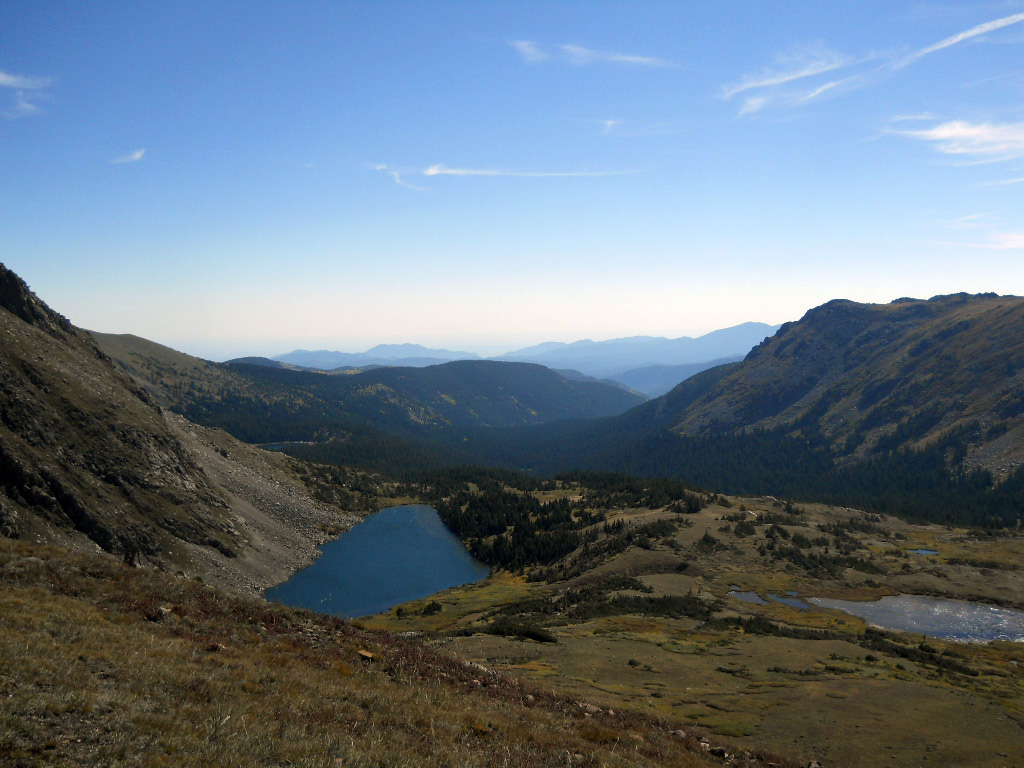
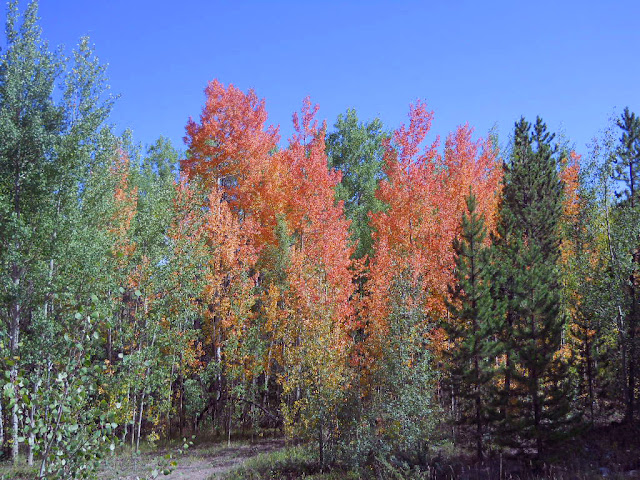
Been getting in a couple of easy, recovery runs off of Crooked Creek. The fall colors are just starting (see photos below) and the air temperature is simply perfect. This is perhaps the best time of year to run in the mountains. I have a couple plans for some bigger loops in the next couple weeks, but have to get my legs recover from Sunday's race.
Monday: Off
Tuesday: 1 hour easy jog.
Wednesday: 1.5 hour run with ~500 vert.
Thursday: 1.5 hour run with ~1,300 vert.
Two new interesting studies have just been published. We all know that running on roads is not the best, first because cement or asphalt is harder then dirt or grass and has more of an impact on the body and muscles. Secondly, because roads are cambered they can lead to potential injury since one leg will be subjected to a slightly different road-to-hip height. Now a new study has been published that tried to look at the impacts of running on a cambered surface a little closer. Entitled "What is the Influence of Cambered Running Surface on Lower Extremity Muscle Activity?", the authors found that running on a road camber alters the activity of select lower extremity muscles - specifically the tibialis anterior, lateral gastrocnemius, and vastus medialis oblique - in response to lower extremity compensations to the cambered surface. The authors did not link the altered lower extremity muscle activity directly to potential injury, but if one leg is experiencing altered muscle activity, there is a good chance something will eventually happen due to the imbalance.
The second study examined whether resistance running would play a beneficial role in hippocampus-related cognitive functions, particularly spatial memory. Using rats (because most studies done on cognitive functioning use rats, and the findings are then extrapolated to the human brain) the authors found that it is not the distance involved in running that is beneficial to hippocampus-related cognitive functioning, but the work level or effort level that is. Specifically they found that resistance running played a beneficial role in hippocampus-related cognitive functions associated with hippocampal brain-derived neurotrophic factors. What are brain-derived neurotrophic factors (BDNF)? BDNFs are proteins that act on certain neurons of the central nervous system and the peripheral nervous system, and help in supporting the survival of existing neurons, as well as encouraging the growth and differentiation of new neurons and synapses. In essence, the authors found that resistance running (or any running really) helps with the creation and maintenance of neurons in the hippocampus. So, not only is running good for your body, but its good for the brain. Something I think most runners already know based on their own phenomenological experiences, but its great to see science back up phenomenology!


Been getting in a couple of easy, recovery runs off of Crooked Creek. The fall colors are just starting (see photos below) and the air temperature is simply perfect. This is perhaps the best time of year to run in the mountains. I have a couple plans for some bigger loops in the next couple weeks, but have to get my legs recover from Sunday's race.
Monday: Off
Tuesday: 1 hour easy jog.
Wednesday: 1.5 hour run with ~500 vert.
Thursday: 1.5 hour run with ~1,300 vert.
Two new interesting studies have just been published. We all know that running on roads is not the best, first because cement or asphalt is harder then dirt or grass and has more of an impact on the body and muscles. Secondly, because roads are cambered they can lead to potential injury since one leg will be subjected to a slightly different road-to-hip height. Now a new study has been published that tried to look at the impacts of running on a cambered surface a little closer. Entitled "What is the Influence of Cambered Running Surface on Lower Extremity Muscle Activity?", the authors found that running on a road camber alters the activity of select lower extremity muscles - specifically the tibialis anterior, lateral gastrocnemius, and vastus medialis oblique - in response to lower extremity compensations to the cambered surface. The authors did not link the altered lower extremity muscle activity directly to potential injury, but if one leg is experiencing altered muscle activity, there is a good chance something will eventually happen due to the imbalance.
The second study examined whether resistance running would play a beneficial role in hippocampus-related cognitive functions, particularly spatial memory. Using rats (because most studies done on cognitive functioning use rats, and the findings are then extrapolated to the human brain) the authors found that it is not the distance involved in running that is beneficial to hippocampus-related cognitive functioning, but the work level or effort level that is. Specifically they found that resistance running played a beneficial role in hippocampus-related cognitive functions associated with hippocampal brain-derived neurotrophic factors. What are brain-derived neurotrophic factors (BDNF)? BDNFs are proteins that act on certain neurons of the central nervous system and the peripheral nervous system, and help in supporting the survival of existing neurons, as well as encouraging the growth and differentiation of new neurons and synapses. In essence, the authors found that resistance running (or any running really) helps with the creation and maintenance of neurons in the hippocampus. So, not only is running good for your body, but its good for the brain. Something I think most runners already know based on their own phenomenological experiences, but its great to see science back up phenomenology!


Tuesday, September 4, 2012
Another Study In Support Of Ischemic Preconditioning - Or Blood Flow Reduction For Increased Running Performance
Another Study in Support of Ischemic Preconditioning - Or Blood Flow Reduction For Increased Running Performance
Earlier in August, I posted about a study that involved ischemic preconditioning on lactate accumulation and running performance. The study found that the runners receiving ischemic preconditioning (ICP) improved their 5k times by 34 seconds, which is a large margin of improvement. The study found that by repeatedly cutting off the blood to the legs, and then allowing them to recover, the leg muscles were better able to deal with the final lactate accumulation that took place during a 5k. In essence, the leg muscles became temporarily more efficient at processing oxygen and in putting off lactate accumulation, something every runner can benefit from. Now a new study has just been published that corroborates this earlier study and lends more support to ICP. Entitled "Remote ischemic preconditioning prevents reduction in brachial artery flow-mediated dilation after strenuous exercise" this study examined how ICP may prevent a reduction in blood flow in the brachial artery. The brachial artery is the major blood vessel of the upper arm. Yes, the upper arm. So, in essence this study looked at whether ischemic preconditioning (cutting blood off and then allowing the muscles and arteries to recover in a repeated fashion) in the lower limbs would have a beneficial affect on the blood vessels in other parts of the body. The authors found that yes, ICP of the lower limbs has a beneficial impact on blood vessels in other parts of the body, in this case the brachial artery of the upper arm. Just like in the other study, which found that ICP can help with lactate accumulation, this study lends support to the idea of looking at the body as an ecosystem, not as individual parts, organs, or regions. By showing that ICP of the lower limbs can keep the blood vessels in other parts of the body at a pre-exercise endothelial functioning (the balance between vasodilation and vasoconstriction), then the reverse is also likely true. By this I am implying that the health of the upper body will have a direct affect on the lower body, and as this study shows, vice versa. Perhaps this is why many nordic skiers are such good runners, and have such high VO2max's. Because they condition their upper body when nordic skiing (without adding much potentially detrimental weight), this "fitness" also has beneficial affects on their lactate accumulation, endurance abilities, and running performances. Everyone knows Kilian Jornet ski races in the winter and rarely runs during that time. Maybe beyond just keeping him in amazing shape during the winter, ski racing also helps directly with running during the summer.
The science does not go that far, but it is interesting to think about. I picked up nordic skis for this winter and will apply some of this conjecturing to myself and see what happens.
Earlier in August, I posted about a study that involved ischemic preconditioning on lactate accumulation and running performance. The study found that the runners receiving ischemic preconditioning (ICP) improved their 5k times by 34 seconds, which is a large margin of improvement. The study found that by repeatedly cutting off the blood to the legs, and then allowing them to recover, the leg muscles were better able to deal with the final lactate accumulation that took place during a 5k. In essence, the leg muscles became temporarily more efficient at processing oxygen and in putting off lactate accumulation, something every runner can benefit from. Now a new study has just been published that corroborates this earlier study and lends more support to ICP. Entitled "Remote ischemic preconditioning prevents reduction in brachial artery flow-mediated dilation after strenuous exercise" this study examined how ICP may prevent a reduction in blood flow in the brachial artery. The brachial artery is the major blood vessel of the upper arm. Yes, the upper arm. So, in essence this study looked at whether ischemic preconditioning (cutting blood off and then allowing the muscles and arteries to recover in a repeated fashion) in the lower limbs would have a beneficial affect on the blood vessels in other parts of the body. The authors found that yes, ICP of the lower limbs has a beneficial impact on blood vessels in other parts of the body, in this case the brachial artery of the upper arm. Just like in the other study, which found that ICP can help with lactate accumulation, this study lends support to the idea of looking at the body as an ecosystem, not as individual parts, organs, or regions. By showing that ICP of the lower limbs can keep the blood vessels in other parts of the body at a pre-exercise endothelial functioning (the balance between vasodilation and vasoconstriction), then the reverse is also likely true. By this I am implying that the health of the upper body will have a direct affect on the lower body, and as this study shows, vice versa. Perhaps this is why many nordic skiers are such good runners, and have such high VO2max's. Because they condition their upper body when nordic skiing (without adding much potentially detrimental weight), this "fitness" also has beneficial affects on their lactate accumulation, endurance abilities, and running performances. Everyone knows Kilian Jornet ski races in the winter and rarely runs during that time. Maybe beyond just keeping him in amazing shape during the winter, ski racing also helps directly with running during the summer.
The science does not go that far, but it is interesting to think about. I picked up nordic skis for this winter and will apply some of this conjecturing to myself and see what happens.
Monday, September 3, 2012
Breck Crest Marathon
Breck Crest Marathon
Yesterday was the 17th annual Breck Crest Mountain Marathon. Held in Breckenridge, the race starts along the river walk, meanders through town briefly before hopping onto the Burro Trail at the ski area. From there, the race follows single track and jeep roads for 3,000' up onto the "crest" of the Ten Mile Range before dropping over onto the Copper side of the range and descending about 1,000'. Hooking up with the Colorado Trail, the course then climbs back up to the crest, and heads east towards Frisco and Dillon Rez. Finally, after some time the course drops down and then heads back towards Breck on the Peaks trail. This was my first time running the race and running any of these trails, although I've done the Ten Mile traverse from Frisco to Peak 10 and down.

The race started with both the full marathon runners and the half marathon runners, who split off at Aid Station #2, so it was difficult to tell who was in what race and exactly how fast of a pace to head out with. I stayed somewhat behind the lead group, feeling fairly good but not 100%. Because you don't start directly on single track, there is plenty of initial room to get a good position and then work your way up. My goal was to get to Aid #3 by 2 hours (since I was hoping for a 4 hour time), which I did. However, Aid #3 is not the halfway point, so I guess I should have shot for a slightly faster time. I was feeling good until around Aid #4, at which point I started to fade and really struggled with the final 6 miles of rolling terrain back to Breck, not to mention the final 2 miles through town on pavement. I ended up with a time of 4:33:29 good for 21st place. The RD did an excellent job, the stations were well stoked, people were friendly, and overall it was a great race. My only complaint is that the Peaks Trail is super popular, so you have to dodge LOTs of hikers, mountain bikers, dogs, etc. which can prove to be tiresome and annoying when you are racing. But I guess that is just one "aspect" of the course.
I've really learned a lot this summer. It has been my first time ever racing, and trying to balance all of the different aspects while still putting in a good performance has been hard. Working on fuel prior to and during the race has been an interesting challenge. Likewise, figuring out how to taper and just how much has also been a challenge. Finally, just racing itself has been interesting - learning to deal with the psychology of the race, other competitors, people behind and in front of you, the adrenaline, and so forth have all shown me that I still have a lot to learn. Running in the mountains is one thing, but racing in the mountains is almost an entirely different thing. Right now I'm really enjoying both, and I know I can do better at the races if I can just figure everything out. Obviously, it takes more then one summer and six races to get a handle on all of the psychological, nutritional, and race-related aspects associated with racing, but I've really enjoyed it. I'm really excited to try and keep some fitness through the winter (and not just start running in April after 6 months of doing no running or endurance activities like I did this year) and see if I can't perform better next summer (or maybe just this fall - the season is not over yet). Either way, adding in some racing has really livened up the summer and brought an entirely new aspect to running that I have enjoyed. Now just to put in a good time!
Yesterday was the 17th annual Breck Crest Mountain Marathon. Held in Breckenridge, the race starts along the river walk, meanders through town briefly before hopping onto the Burro Trail at the ski area. From there, the race follows single track and jeep roads for 3,000' up onto the "crest" of the Ten Mile Range before dropping over onto the Copper side of the range and descending about 1,000'. Hooking up with the Colorado Trail, the course then climbs back up to the crest, and heads east towards Frisco and Dillon Rez. Finally, after some time the course drops down and then heads back towards Breck on the Peaks trail. This was my first time running the race and running any of these trails, although I've done the Ten Mile traverse from Frisco to Peak 10 and down.

The race started with both the full marathon runners and the half marathon runners, who split off at Aid Station #2, so it was difficult to tell who was in what race and exactly how fast of a pace to head out with. I stayed somewhat behind the lead group, feeling fairly good but not 100%. Because you don't start directly on single track, there is plenty of initial room to get a good position and then work your way up. My goal was to get to Aid #3 by 2 hours (since I was hoping for a 4 hour time), which I did. However, Aid #3 is not the halfway point, so I guess I should have shot for a slightly faster time. I was feeling good until around Aid #4, at which point I started to fade and really struggled with the final 6 miles of rolling terrain back to Breck, not to mention the final 2 miles through town on pavement. I ended up with a time of 4:33:29 good for 21st place. The RD did an excellent job, the stations were well stoked, people were friendly, and overall it was a great race. My only complaint is that the Peaks Trail is super popular, so you have to dodge LOTs of hikers, mountain bikers, dogs, etc. which can prove to be tiresome and annoying when you are racing. But I guess that is just one "aspect" of the course.
I've really learned a lot this summer. It has been my first time ever racing, and trying to balance all of the different aspects while still putting in a good performance has been hard. Working on fuel prior to and during the race has been an interesting challenge. Likewise, figuring out how to taper and just how much has also been a challenge. Finally, just racing itself has been interesting - learning to deal with the psychology of the race, other competitors, people behind and in front of you, the adrenaline, and so forth have all shown me that I still have a lot to learn. Running in the mountains is one thing, but racing in the mountains is almost an entirely different thing. Right now I'm really enjoying both, and I know I can do better at the races if I can just figure everything out. Obviously, it takes more then one summer and six races to get a handle on all of the psychological, nutritional, and race-related aspects associated with racing, but I've really enjoyed it. I'm really excited to try and keep some fitness through the winter (and not just start running in April after 6 months of doing no running or endurance activities like I did this year) and see if I can't perform better next summer (or maybe just this fall - the season is not over yet). Either way, adding in some racing has really livened up the summer and brought an entirely new aspect to running that I have enjoyed. Now just to put in a good time!
Tuesday, August 28, 2012
Running Surfaces and Aerobic Performance on Finish Time in Mountain Running
Running Surfaces and Aerobic Performance on Finish Time in Mountain Running
Two new studies have just been published. The first study, which examined running surfaces and impacts to total stress on the musculoskeletal system, found out what most trail runners already know - running on grass is better for you then asphalt, concrete, and rubber (tracks). What surprises me is that the authors state that there is still controversy in the literature regarding the biomechanical effects of different types of running surfaces on foot–floor interaction. Really? I thought that was covered back in the 80s or even earlier. However, that may have just been non-scientific hype when trail running was just getting "popular" and part of the sales pitch to get road runners to switch over to trails. Well, now we have scientific proof that running on softer surfaces is better for you.
The second study looked at individual aerobic performance on finish time in mountain running. The authors analyzed data from 869 finishers of 3 international mountain running competitions and found that the difference in anaerobic threshold between the winners is about 7 times greater then those in the back-of-the-pack. 7 times!! That is a big difference in anaerobic threshold. What does that mean for those striving to improve their times and performances in mountain competitions. One, it means they have to work really, really hard, but it also means that there is most likely a law of diminishing returns for those of us trying to get better. Once we start training to boost our VO2max and anaerobic threshold, we will see big returns and steadily move up in results. However, after more and more training, eventually we will near our physiological limit for VO2max, and our progress will become more and more finite. Whether the gap between one's untrained VO2max and one's highly trained VO2max is seven times greater is unknown (that is not what this study looked at), it does continue to lend weight to the philosophy that you need to include speed/interval/hill workouts into your running training if you want to reach your potential. Since these training methods do work to increase one's VO2max, while simply running at altitude does not, the science continues to argue for one to incorporate a little speed/interval/hill training into their workouts. The big question, however, is whether a combination of altitude and speed/interval/hill would work to increase one's VO2max even more then without altitude. The science is still out on that question, but I think it just might.
Update: Set a new PR on my 15K loop today. The old was 1:11, but the new one is 1:09. This is a loop run with 1,700' of elevation gain that I use as my speed training loop. My time continues to drop (to my surprise), and since it is at 9,100' in elevation, I think there may be something to training at altitude that most scientific studies have not gotten to yet. Altitude alone doesn't really provide any noticeable benefits, but systematic training (with speed workouts, intervals, hill repeats, etc.; and not just daily mountain runs) just might.
Two new studies have just been published. The first study, which examined running surfaces and impacts to total stress on the musculoskeletal system, found out what most trail runners already know - running on grass is better for you then asphalt, concrete, and rubber (tracks). What surprises me is that the authors state that there is still controversy in the literature regarding the biomechanical effects of different types of running surfaces on foot–floor interaction. Really? I thought that was covered back in the 80s or even earlier. However, that may have just been non-scientific hype when trail running was just getting "popular" and part of the sales pitch to get road runners to switch over to trails. Well, now we have scientific proof that running on softer surfaces is better for you.
The second study looked at individual aerobic performance on finish time in mountain running. The authors analyzed data from 869 finishers of 3 international mountain running competitions and found that the difference in anaerobic threshold between the winners is about 7 times greater then those in the back-of-the-pack. 7 times!! That is a big difference in anaerobic threshold. What does that mean for those striving to improve their times and performances in mountain competitions. One, it means they have to work really, really hard, but it also means that there is most likely a law of diminishing returns for those of us trying to get better. Once we start training to boost our VO2max and anaerobic threshold, we will see big returns and steadily move up in results. However, after more and more training, eventually we will near our physiological limit for VO2max, and our progress will become more and more finite. Whether the gap between one's untrained VO2max and one's highly trained VO2max is seven times greater is unknown (that is not what this study looked at), it does continue to lend weight to the philosophy that you need to include speed/interval/hill workouts into your running training if you want to reach your potential. Since these training methods do work to increase one's VO2max, while simply running at altitude does not, the science continues to argue for one to incorporate a little speed/interval/hill training into their workouts. The big question, however, is whether a combination of altitude and speed/interval/hill would work to increase one's VO2max even more then without altitude. The science is still out on that question, but I think it just might.
Update: Set a new PR on my 15K loop today. The old was 1:11, but the new one is 1:09. This is a loop run with 1,700' of elevation gain that I use as my speed training loop. My time continues to drop (to my surprise), and since it is at 9,100' in elevation, I think there may be something to training at altitude that most scientific studies have not gotten to yet. Altitude alone doesn't really provide any noticeable benefits, but systematic training (with speed workouts, intervals, hill repeats, etc.; and not just daily mountain runs) just might.
Sunday, August 26, 2012
XTERRA Snow Mountain Ranch 20K
XTERRA Snow Mountain Ranch 20K
This morning was the XTERRA Snow Mountain Ranch 20K trail race at Snow Mountain Ranch just outside of Tabernash. Although there was frost on the ground and I had to use the ice scraper on the car this morning, the day got hot fast. The course was really nice, winding through aspen forests, meadows, willow thickets, some lodgepole pines - all on trails with a few sections of dirt road. I would recommend this race to anyone; the course is really nice, the location is spectacular, and the volunteers and crew were great. Next year they are going to offer a full trail marathon, and not the 20K, so that may be something to put on your radar.
I started off with the lead group, keeping pace with them through the first couple miles, but had to drop back a bit on the initial 1,000' climb. Although I had tapered and rested, I'm still trying to figure out just how to race. I thought I was rested and would be good, but for some reason I wanted to hurl on the climb and was having trouble getting my breathing into a rhythm - I think it was mostly adrenaline as after about mile 5 I got into a good groove and was able to run the flats and hills really well. It surprised me a bit, as I didn't feel too nervous prior to the race, but obviously I was and need to keep working on the mental and physical game of racing. After the first big climb, the course was mostly rolling with some steep downs and a couple short ups. When I let the lead pack go on the climb, there was no one behind me so I ran the rest of the race solo, which was nice but I think I might have been able to get a slightly better time if there had been a rabbit in front or someone closing in on me and pushing me to go faster. Again, learning to race - something I have never done but find really quite interesting in all of its complexities and nuances.
Anyway, a great race on a killer course. The trails are open to the public if you buy a day pass at the Ranch, which is something to do now that fall colors are starting to show. It really is a beautiful setting. I got 6th place with a time of 1:50:49. Pretty happy, but obviously there is room for improvement; improvement that I think will come with more racing experience.
This morning was the XTERRA Snow Mountain Ranch 20K trail race at Snow Mountain Ranch just outside of Tabernash. Although there was frost on the ground and I had to use the ice scraper on the car this morning, the day got hot fast. The course was really nice, winding through aspen forests, meadows, willow thickets, some lodgepole pines - all on trails with a few sections of dirt road. I would recommend this race to anyone; the course is really nice, the location is spectacular, and the volunteers and crew were great. Next year they are going to offer a full trail marathon, and not the 20K, so that may be something to put on your radar.
I started off with the lead group, keeping pace with them through the first couple miles, but had to drop back a bit on the initial 1,000' climb. Although I had tapered and rested, I'm still trying to figure out just how to race. I thought I was rested and would be good, but for some reason I wanted to hurl on the climb and was having trouble getting my breathing into a rhythm - I think it was mostly adrenaline as after about mile 5 I got into a good groove and was able to run the flats and hills really well. It surprised me a bit, as I didn't feel too nervous prior to the race, but obviously I was and need to keep working on the mental and physical game of racing. After the first big climb, the course was mostly rolling with some steep downs and a couple short ups. When I let the lead pack go on the climb, there was no one behind me so I ran the rest of the race solo, which was nice but I think I might have been able to get a slightly better time if there had been a rabbit in front or someone closing in on me and pushing me to go faster. Again, learning to race - something I have never done but find really quite interesting in all of its complexities and nuances.
Anyway, a great race on a killer course. The trails are open to the public if you buy a day pass at the Ranch, which is something to do now that fall colors are starting to show. It really is a beautiful setting. I got 6th place with a time of 1:50:49. Pretty happy, but obviously there is room for improvement; improvement that I think will come with more racing experience.
Wednesday, August 22, 2012
More Science Is Needed - Altitude Training And Running Performance
More Science is Needed - Altitude Training and Running Performance
Two new articles just published on altitude training and running or exercise performance. The first, entitled "The role of haemoglobin mass on VO2max following normobaric ‘live high–train low’ in endurance-trained athletes" looked at two possible mechanisms that the live high-train low method may have on boosting running performance. The first theory is that living high and training low will help improve maximal oxygen uptake (VO2max) and that this improvement is related to hypoxia-induced increases in total haemoglobin mass. The other contending theory is that living high and training low improves maximal oxygen uptake (VO2max) and that this improvement is related to improved maximal oxidative capacity of skeletal muscle. Surprisingly the authors found that after a 4 week period of living high and training low, athletes showed no improvement in VO2max (they did use elite cyclists rather then elite runners, but one would assume that would not make a difference)! This is also interesting in light of other research that seems to indicate that speed training does boost VO2max. So, why not altitude? Perhaps it is because the subjects/athletes in this study did not perform rigorous training exercises? The jury seems to be still out on this contentious subject.
This is reflected in the second study published recently: "Does ‘altitude training’ increase exercise performance in elite athletes?" Although a review article, it makes a good point in that we really have not investigated altitude training in any comprehensive, scientific way. For example, the scientific gold-standard design of a double-blind, placebo-controlled, cross-over trial has never been conducted on altitude training! So, although people swear by it (including me, although like I've said previously, I do more live high-train high), the scientific research on altitude training is too nascent to come to any positive conclusions. Hopefully this subject will be taken up with more vigor in the coming years.
As for me and my running, I got a new PR on my ~15K loop today with 1:11:40, dropping two minutes off my previous PR. I guess that means its time to add on some new miles to the loop as I would prefer my fast run to take about 1:30.
Two new articles just published on altitude training and running or exercise performance. The first, entitled "The role of haemoglobin mass on VO2max following normobaric ‘live high–train low’ in endurance-trained athletes" looked at two possible mechanisms that the live high-train low method may have on boosting running performance. The first theory is that living high and training low will help improve maximal oxygen uptake (VO2max) and that this improvement is related to hypoxia-induced increases in total haemoglobin mass. The other contending theory is that living high and training low improves maximal oxygen uptake (VO2max) and that this improvement is related to improved maximal oxidative capacity of skeletal muscle. Surprisingly the authors found that after a 4 week period of living high and training low, athletes showed no improvement in VO2max (they did use elite cyclists rather then elite runners, but one would assume that would not make a difference)! This is also interesting in light of other research that seems to indicate that speed training does boost VO2max. So, why not altitude? Perhaps it is because the subjects/athletes in this study did not perform rigorous training exercises? The jury seems to be still out on this contentious subject.
This is reflected in the second study published recently: "Does ‘altitude training’ increase exercise performance in elite athletes?" Although a review article, it makes a good point in that we really have not investigated altitude training in any comprehensive, scientific way. For example, the scientific gold-standard design of a double-blind, placebo-controlled, cross-over trial has never been conducted on altitude training! So, although people swear by it (including me, although like I've said previously, I do more live high-train high), the scientific research on altitude training is too nascent to come to any positive conclusions. Hopefully this subject will be taken up with more vigor in the coming years.
As for me and my running, I got a new PR on my ~15K loop today with 1:11:40, dropping two minutes off my previous PR. I guess that means its time to add on some new miles to the loop as I would prefer my fast run to take about 1:30.
Monday, August 20, 2012
Jones Pass Loop - Time on the Divide
Jones Pass Loop - Time on the Divide
This morning, despite the clouds and threatening rain, I ran the Jones Pass loop. This is an excellent loop that features a fair bit of time on the Continental Divide above 12,000'. Although the loop is only ~14 miles, eight of those miles are above 12,000' and stay directly on the Divide, making this loop a great run for altitude and views. Plus, you get to tag one named peak (Hassell Peak at 13,215') and about 6 unnamed 12,000+ mini-peaks. The loop starts at the winter parking lot near the Henderson Mine at the base of the Jones Pass road. Run up the road, but then take your first left up Butler Gulch. Follow the old, closed mining road up into the Butler Gulch basin until you get to just past treeline. At this point, angle left/south and find a goat trail that will take you up onto the ridge running east off of Hassell Peak. Once on this ridge, run along it until you climb up and eventually reach the Divide. From here, you are on the Continental Divide Trail (perhaps one of the best sections, and one of the longest sections of the trail that is above 12,000'), and a quick jaunt south will take you to the top of Hassell Peak (I've run this a couple times; an alternative is to run Hassell Peak from the Herman Gulch trailhead). From the top of Hassel, simply head north on the Divide. You can either stay on the trail, which skirts the Divide itself, or as I did today, tag all of the little summits along the Divide (about 6 unnamed 12,000' peaks). Keep running north on the Divide past the Jones Pass road, tagging three more mini-peaks before heading east and dropping down along a ridge that splits the West Fork of Clear Creek with Vasquez Creek. The trail drops down, then turns south and angles along the western slopes of Vasquez Peak until connecting up with the trail to Stanley Mountain. At this point, just drop down a couple switchbacks and you are back at the start. Like I said, although this loop is only ~14 miles, it has over 5,256' of elevation gain, so it still packs a punch. It took me 3:23 today, with stops on Hassel and a few other spots for photos. You can go faster if you stay on the actual trail and don't tag all of the mini-summits.


This morning, despite the clouds and threatening rain, I ran the Jones Pass loop. This is an excellent loop that features a fair bit of time on the Continental Divide above 12,000'. Although the loop is only ~14 miles, eight of those miles are above 12,000' and stay directly on the Divide, making this loop a great run for altitude and views. Plus, you get to tag one named peak (Hassell Peak at 13,215') and about 6 unnamed 12,000+ mini-peaks. The loop starts at the winter parking lot near the Henderson Mine at the base of the Jones Pass road. Run up the road, but then take your first left up Butler Gulch. Follow the old, closed mining road up into the Butler Gulch basin until you get to just past treeline. At this point, angle left/south and find a goat trail that will take you up onto the ridge running east off of Hassell Peak. Once on this ridge, run along it until you climb up and eventually reach the Divide. From here, you are on the Continental Divide Trail (perhaps one of the best sections, and one of the longest sections of the trail that is above 12,000'), and a quick jaunt south will take you to the top of Hassell Peak (I've run this a couple times; an alternative is to run Hassell Peak from the Herman Gulch trailhead). From the top of Hassel, simply head north on the Divide. You can either stay on the trail, which skirts the Divide itself, or as I did today, tag all of the little summits along the Divide (about 6 unnamed 12,000' peaks). Keep running north on the Divide past the Jones Pass road, tagging three more mini-peaks before heading east and dropping down along a ridge that splits the West Fork of Clear Creek with Vasquez Creek. The trail drops down, then turns south and angles along the western slopes of Vasquez Peak until connecting up with the trail to Stanley Mountain. At this point, just drop down a couple switchbacks and you are back at the start. Like I said, although this loop is only ~14 miles, it has over 5,256' of elevation gain, so it still packs a punch. It took me 3:23 today, with stops on Hassel and a few other spots for photos. You can go faster if you stay on the actual trail and don't tag all of the mini-summits.


Hassell Peak with the ridge (the other small red dot) that you climb out of Butler Gulch

Looking down on Hassell Lake in the Woods Creek basin

The red dot is where you are going, keeping on the ridge along the entire way

Looking at Pettingell Peak from Hassell

Evans and Bierdstat (in the distance) and Bard, Parnassus, and Woods Peaks in the front (left to right - part of the Ruby Creek Traverse)

Looking back at Hassell Peak after crossing Jones Pass and tagging the first mini-peak

Looking all the way back at Hassell Peak from the last mini-peak before heading down
Subscribe to:
Posts (Atom)